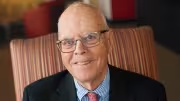
Harvard Magazine has long published commentaries from the president on matters that are timely and relevant to the life of the University. In an era of rapid news cycles, it can be challenging to craft copy that made sense given the long lead times for the magazine’s bimonthly production schedule. We are pleased, therefore, to resume such essays from President Alan M. Garber as his schedule permits, for rapid publication online.
—The Editors
Much has changed since I arrived on campus as an undergraduate in 1973. In recent years, as provost and now as president, I’ve been able to play a role in some of those changes, which were possible because, as a community, we have resisted the easy comfort of a sense of complacency. Pushing the boundaries of our mission into new and exciting areas of promise—especially broadening access to a Harvard education—is what we’re about.
Many would-be students are deterred by the fear that they won’t be able to afford a Harvard education. That is why we devote considerable resources to financial aid—more than $749 million across the University last year, one-third of it for the support of students in Harvard College. Our expanded undergraduate financial aid program, announced last week and going into effect this fall, will pay for tuition, housing, food, and other expenses for students from families with incomes of $100,000 or less. Harvard will be tuition-free for students from families with incomes of $200,000 or less. When we bring down the financial barriers to a Harvard education, a goal nearly as old as the University itself, we attract students with different backgrounds, experiences, and perspectives, enriching the residential learning environment for everyone.
As we support students who pursue degree programs on our campus, we also continue to reach learners around the world. By the time edX, our joint online learning platform with MIT, was acquired nine years after its launch, we had reached 39 million individuals through more than 2,800 courses offered by our two institutions and nearly 200 partner universities. Our experience not only revealed unexpected ways in which the real and the virtual complement one another, it also instilled in us a deeper appreciation for the work that is still to be done. We are approaching much of that work through Axim Collaborative, a non-profit Harvard and MIT created with proceeds from the sale of edX. Its purpose is to expand access to education and meet the needs of underserved students. Axim is developing and funding partnerships with broad access institutions such as community colleges, as well as technology innovators and research organizations, to enable success, encourage persistence, and create career options after postsecondary study. This effort, still in its early days, promises a future in which millions of learners have the opportunity to fulfill their potential regardless of their personal circumstances.
As our 400th anniversary draws near, we are reminded that one does not need to enter the Yard through Dexter Gate or even visit our physical campus to benefit from Harvard teaching and grow in wisdom. We will continue to remove impediments to access and create new avenues to achievement, guided by our commitment to excellence in the pursuit and dissemination of knowledge. There is, as always, much for us to learn, much for us to gain, and much for us to contribute to education on our campus and far beyond it. I am eager to continue advancing on this important front.