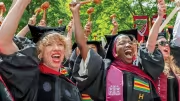
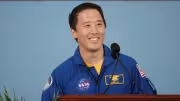
At Thursday afternoon’s convocation ceremony for Harvard Medical School and the School of Dental Medicine, Wellesley College President Paula A. Johnson ’80, M.D. ’84, M.P.H. ’85, called on the graduates to be “citizen-physicians.” “To be able to heal confers an obligation to heal,” she told them. And she urged them to meet the current political moment with honesty and humanity. “In an atmosphere of mistrust,” she said, “it is critically important for clinical physicians and physician scientists to be able to translate their knowledge, their practice, and their science into the public domain.”
Laying out the stakes, she added, “Harvard is fighting hard as we speak, both for the academic freedom that allows the truth to be told and also for the academic freedom that allows the rigorous pursuit of truth in the first place.”
That fight comes, she said, amid other profound challenges that medicine has faced in recent years, including the COVID-19 pandemic, which accelerated an already existing decline in public confidence in science and medicine. Medical disinformation, which has become “rampant” on social media, contributed to the decline, Johnson said, but “in retrospect, we as physicians and scientists could have been better at clearly explaining what confronting a new pathogen entails.”
The first black woman to lead Wellesley, Johnson trained in cardiology and internal medicine and is an expert in women’s health. She was on the faculty at the Medical School and the T.H. Chan School of Public Health and served as the chief of the women’s health division at Brigham and Women’s Hospital, where she also founded the Connors Center for Women’s Health and Gender Biology. In her remarks, she spoke of the both power of medicine and its remarkable progress, recalling her pediatric rotation in 1983. “One of the diseases that we saw in many patients was sickle cell disease,” she said. “These young people would come into the hospital in crisis, often with damage to their hearts, their kidneys, and their bones. Fast forward to today, we can cure sickle cell disease with gene therapies, which at that point had never been tried in humans.”
Noting the challenges in the public health field, such as medical culture’s past ignorance of sex-based differences in disease, Johnson argued for equality and transparency in healthcare. Trust, cleanliness, self-efficacy, and stable processes, especially in crisis zones, should drive physicians and their work, she said. “People are simply more likely to help a stranger when they have the skills to do so,” she told the graduates, adding, “Never forget your power to improve a life or the systems that impact many lives.”
To emphasize the importance of humanity in medicine, Johnson shared a story about finding herself on the patient side of the doctor-patient relationship. “Some years ago, my daughter faced a devastating medical challenge with a doubtful prognosis,” she said, describing how she threw herself into action, asking questions, researching answers, and seeking out the best specialists she could find. One of those specialists was the late Judah Folkman, who served as the director of vascular biology at Boston Children's Hospital. Johnson recalled that Folkman told her and her husband, “Much is unknown about your daughter's condition, but science is advancing. The fact that there are unknowns gives me hope, and should give you hope as well. Where there’s an unknown, there’s hope for the future.’”
That hope, Johnson said, “was not about false promises.” Quite the contrary, it was about “respect for the limits of current knowledge, humility in the light of those limits, and faith that knowledge would expand in the future and that he would be there to help us. It was also about the clear connection between science and service to people. Most of all, it was about compassion.” Folkman, in other words, was a “citizen-physician.”