L. Mahadevan on What Makes the Asiatic Lily Bloom

A Harvard professor explores the physical forces that open a flower bud.

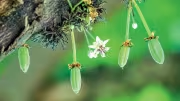
The Asiatic lily, <i>Lilium casablanca.</i>

The Asiatic lily, Lilium casablanca. | Courtesy Flickr user KingsbraeGarden

How do the petals of the white Asiatic lily form and unfurl to become a flaring trumpet? This is the sort of question most people never even think to ask—and if they did ask, might quickly abandon as either insurmountably complex or too trivial to consider. But fundamental and easily overlooked questions fascinate Valpine professor of mathematics Lakshminarayanan Mahadevan. (See his "Applied Math" laboratory website, too.)

Working with Haiyi Liang, formerly a postdoctoral fellow at the School of Engineering and Applied Sciences (SEAS) and now a professor at the University of Science and Technology of China, in Hefei, Mahadevan discovered that rapid growth in cells at the periphery of the petals leads to wrinkle-induced stress within the flower bud that forces it open and drives the subsequent development of the blossom. The discovery has connections to earlier work by Mahadevan on ruffles at the edges of kelp, and, by analogy, to crochet and to the way the brain folds during development, as described in "The Physics of the Familiar," a feature article about his work from Harvard Magazine's archives; see also the associated video of Mahadevan's discoveries.

As former SEAS dean Venkatesh Narayanamurti has said of him, “Maha is not only a tremendous applied mathematician, he truly is a kind of Renaissance thinker. Is he an applied mathematician? Is he an engineer? Is he a computational biologist? Or is he an applied physicist? He is all of the above.”

Related topics

You might also like

Discoveries: Chronic Pain, Cocoa Shortages, and Making Old Lungs Young

Harvard researchers investigate climate’s impact on cocoa crops, innovations in nasal vaccines, and links between pain and skull marrow.

To Promote Healthy Habits in Patients, Start with the Doctors

Why Harvard Medical School is training physicians to think more like coaches

When Government Funding Dropped, Harvard Found Partners

The University is expanding industry ties and investing its own funds to support research, but neither will replace lost federal dollars.

Most popular

A Harvard Astrophysicist Explains the Bizarre Behavior of a Supergiant Star

The dimming and rapid rotation of Betelgeuse may be caused by a hidden companion.

Is Gambling Becoming a Public Health Crisis?

Responding to the explosive growth of online gambling and sports betting, a new report urges governments to regulate with public health in mind.

Harvard Academic Workers Begin Strike

A second union joined graduate students on the picket line, emptying labs and classrooms.

Explore More From Current Issue

St. Peter's Basilica at sunset, illuminated by purple and orange sky reflections in the river.

For advocacy and benevolence, three late alumni are reportedly in line for the Catholic Church’s highest honor.

Collage of book covers featuring various titles on a vibrant orange background.

These newly released novels, histories, and memoirs grapple with identity in all its forms.

Black and white portrait of a woman with medium-length hair, smiling softly.

The outgoing executive director and Harvard Business School graduate went from dancing The Nutcracker to growing a ballet company.