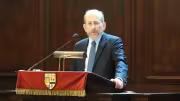
The Harvard Stem Cell Institute (HSCI) has tapped Lee Rubin as its next faculty co-director, the organization announced on Tuesday. Rubin is a professor of stem cell and regenerative biology at Harvard and a renowned scholar on neurodegenerative diseases, including Parkinson’s disease, ALS, and spinal muscular atrophy.
Effective this spring, Rubin will serve alongside David Scadden, the Jordan professor of medicine and professor of stem cell and regenerative biology at Harvard. He succeeds Doug Melton, the former Xander University Professor at Harvard who co-founded HSCI in 2005.
“Lee is joining at a particularly important time for the HSCI,” Scadden said in a university release. “We continue to move toward clinical application of discoveries…and increase emphasis on aging related conditions. He brings experience in both industry and academia along with an outstanding discovery program on the aging brain.”
Rubin, who joined Harvard in 2006, has had a long career in both industry and university research. He earned a bachelor’s in chemistry and psychology from Cornell University and a Ph.D. in neuroscience from Rockefeller University and completed his postdoctoral training in neuroscience at Harvard Medical School and Stanford University.
Rubin was a senior scientist at Athena Neurosciences, where his work on the cell biology of the blood-brain barrier led to the development of Tysabri, a multiple sclerosis drug. He served as a professor of anatomy and developmental biology at University College London, director of the Eisai London Laboratories, and chief scientific officer of the biotechnology firm Curis, Inc., in Cambridge, Massachusetts.
At Harvard, his research focuses on how aging and disease can change the nervous system. His lab uses stem cells to model the onset and development of illness, focusing on producing patient-specific neurons in an effort to develop new therapies and lead to functional improvements in patients. Rubin is also the faculty co-chair for the M.S./M.B.A. Biotechnology: Life Sciences dual master’s degree program between the Faculty of Arts and Sciences and Harvard Business School.
“I have been involved with HSCI from the moment it started,” Rubin said in a statement, “and am excited about the opportunity to help David continue to drive the exciting work carried out by the many HSCI investigators who combine their strong interest in research with an equally strong desire to contribute to the development of new therapeutics.”
Founded in 2005, HSCI is a network of hundreds of scientists and faculty across Harvard researching the use of stem cells to advance medicine across a range of research areas, including cancers, diabetes, blood and cardiovascular diseases, skin diseases, and more.
“I am delighted that Lee has agreed to serve alongside David as co-director of the Harvard Stem Cell Institute,” senior vice provost for research John H. Shaw said in a university statement, adding that Rubin’s body of work “exemplifies HSCI’s commitment to bridging the gap between academic research and real-world cures.”