In a new exhibition at the Radcliffe Institute for Advanced Study, artist Anna Von Mertens uses both drawings and hand-stitched quilts to focus on the life and work of Henrietta Swan Leavitt, A.B. 1892, a female astronomer and “computer” who studied glass-plate astronomical photographs at Harvard a century ago, and whose work led to the first method of measuring distances between stars.
The craftsmanship throughout the exhibit, titled Measure, is careful and meticulous, but Von Mertens, a textile artist, said she hesitates when she hears the word “patient.”“I think [that word] can be very gendered and sort of passive…but it’s not a sweet and passive action to be patient—it’s an active, constant engagement in whatever you’re doing. I notice that nobody ever describes men’s work as patient.”
After visiting the Harvard Observatory last year at the invitation of Jennifer Roberts, Agassiz professor of the humanities and Johnson-Kulukundis Family faculty director of the arts at the Radcliffe Institute, Von Mertens became fascinated by a glass-plate collection that is also the world’s oldest and most comprehensive record of the stars. She was also curious to learn more about the women who studied photographs of the night sky in order to create them. Leavitt was one of those astronomers who tediously, painstakingly—not patiently—tracked the changes in variable stars, which slowly pulse from bright to dim to bright again. She discovered a correlation between the length of time it took a star to pulse and how bright that star actually was, a relationship that allowed astronomers to calculate the star’s distance from Earth. The ultimate result? The first comprehensive picture of the space around us.
For Measure, Von Mertens created a diptych illustrating the nighttime skies on the dates of Leavitt’s birth and death. Software called Starry Night enabled her to go back to a specific place and moment in time to calculate the positioning of the stars, and project those night skies onto fabric taped to the wall. Her approach to actually stitching the stars on cotton fabric with needle and thread is complex: “I assign a value based on the star’s brightness at a scale I created, and then with the computer I play time forward, following that trajectory with chalk on fabric, and then calculating, depending on how bright the star is, how quickly it would fade out with the rising of the sun.” Von Mertens says she stitched the star trails spanning the first hours of dawn on the morning of Leavitt’s birth as well as those that appeared as dusk settled on the evening of her death. Brighter stars have a thick white thread, and some of the dimmer stars are assigned a color somewhere along the grayscale.
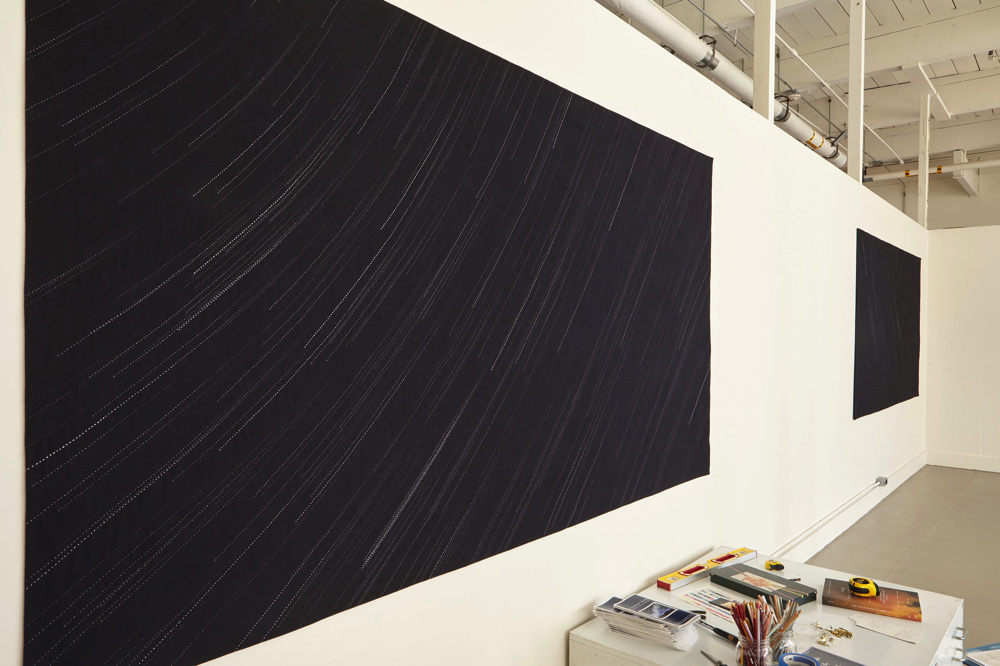
The quilt at left shows the stars fading from view on the morning of Henrietta Leavitt’s birth on July 4, 1868 in Lancaster, Massachusetts; the companion quilt depicts stars returning into view on the evening of Henrietta Leavitt’s death on December 12, 1921 in Cambridge. 2018, hand-stitched cotton, each 54×100 in.
Courtesy of the artist and Elizabeth Leach Gallery
“I don’t like to belabor the process, but to change threads is a pain…As a traditional quilt maker, you would never pile that many stitches on each other, so it really is playing with the form in a way I hadn’t played with it before,” she says. In the process of stitching stars across her quilts, Von Mertens noticed subtle parallels between herself and Leavitt, who spent so much time carefully gauging the relative brightness and distance of one tiny speck from another using sporadic, limited technology.
Aside from the diptych, Measure has several other distinct components. Shape/View, a series completed prior to Von Mertens’s research at the observatory, examines the Milky Way from several different vantage points, and plots those stars by making stitches on fabric. She also created two pencil drawings of the Orion Nebula by examining the glass plates in the observatory.
This is not the first time Von Mertens has translated the night sky into her artwork. In 2006, the Jack Hanley Gallery in San Francisco showed a series of quilts she made, also using Starry Night, depicting the stars above violent moments in American history, including September 11, 2001, and the Battle of Wounded Knee.
Although Measure is as much a technical exploration of the cosmos through unconventional media as it is artwork, Von Mertens says she also became very immersed in Leavitt’s career and life in the course of doing her research. In her artist’s statement, she writes, “There is satisfaction in this narrative arc of history, a validation that Leavitt’s work lives on in the ways it deepens our understanding and shifts our awareness. But there is also a sense of loss. Did Leavitt feel validated in her work? What meaning is contained within her lifetime?”
Given that Leavitt died before the scientific community began to recognize the dramatic implications of her work, Von Mertens says she felt a sense of duty to tell visitors as much about her life as possible through the artworks themselves. “If I do nothing else in this body of work, I want to tell Henrietta Leavitt’s story,” she says. “It became part of my process to tell the stories of these women, working together on this repetitive task that they were assigned, and what they built from there.”