 |
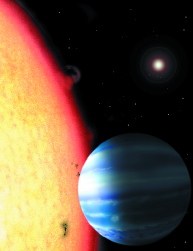
| An artist's rendering of OGLE-TR-56b and its star |
| Illustration courtesy Harvard-Smithsonian Center for Astrophysics |
Five thousand light years from Earth, in the constellation Sagittarius, astronomers have discovered a planet by observing its direct transit in front of its star. This is a first. All of the 100 or so known extrasolar planets orbiting normal stars have been discovered using indirect evidence, such as the "wobble" their gravity produces on nearby celestial bodies (see "Distant Planets," July-August 2000, page 22, and "Orbiting Other Suns," September-October 1998, page 16). At the Harvard-Smithsonian Center for Astrophysics, however, a group led by Cabot associate professor of astronomy Dimitar Sasselov identified planet OGLE-TR-56b by observing that light from its star dimmed minutely when the planet passed across the star's face (see
https://cfa-www.harvard.edu/press/pr0301.html). Sasselov compares the effect to "a mosquito passing in front of a searchlight 200 miles away." The world's largest optical telescope, the 10-meter Keck I telescope in Hawaii, confirmed the finding.
The complex new technique that found OGLE-TR-56bat a distance 20 times greater than that of any previous comparable bodyvastly extends the field of search for extrasolar planets, enlarging it from 40,000 candidate stars to 100 million or more. OGLE-TR-56b, a gaseous body, is larger than Jupiter, yet orbits only 2 million miles away from its star. (Earth is 93 million miles from the Sun.) Hence its years last only 29 hours, while the surface temperature rises to 3000 degrees Fahrenheit, which may cause unusual weather: rain droplets not of water, but iron.