Every Wednesday at seven in the morning, Leland Cole ’57 and 10 other Cincinnati business leaders get together for breakfast. The meetings started in 1995, when they were charged with the business component of Cincinnati’s Sister City project with Kharkiv, Ukraine. “We had no idea what to do initially,” Cole confesses. Then the retired computer executive came across an article on ex-communist economies in Foreign Affairs. He contacted the authors and they began discussing its thesis: that countries in the former Soviet Union could benefit from strategies used for the Marshall Plan (which, like Cole, celebrates a reunion this year, having been announced at Harvard on Commencement afternoon in 1947). Eventually Cole was inspired to found the nonprofit Center for Economic Initiatives (CEI; www.ceiworld.org), which uses the technical-assistance aspects of the Marshall Plan to foster economic opportunities in the developing world, focusing initially on Ukraine, Kazakhstan, and Moldova.
 |
The Center for Economic Initiatives |
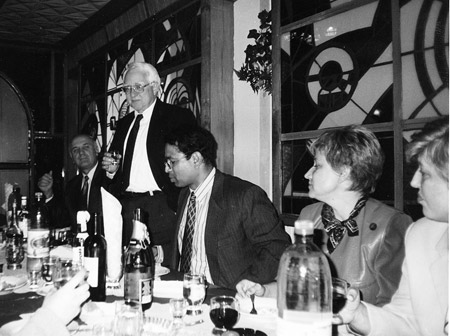
Leland Cole toasts executives from Ukraine’s food-processing-equipment industry who had previously participated in a CEI study tour. |
Through internships and study tours, CEI brings eastern Europeans to the United States to observe best-industry practices; 280 Ukrainian executives have come thus far, for example, during 17 training missions. “Their companies are typically 20 or 30 years behind ours,” Cole says, “so their leaders get an invaluable look at the future. We get to know the participants during their first interviews, overseas; then we meet them on the tours, and six months later, we interview them again. In only six months we can see the change—they just ooze confidence. You can’t put a dollar amount on that.”
But the financial impact of CEI programs has in fact been evaluated at more than 18 times their cost. Cole’s favorite example dates from 1998, when some Kharkiv engineers noticed that cooling systems in American dairies were on the ceiling, not the floor, to better circulate the air. Back in Ukraine, the engineers saved 30 percent on energy costs after implementing that change. “It’s something that’s obvious, but doesn’t occur to you until you’ve seen it,” Cole says. “We help with simple things, not rocket science.”
CEI offers other technical-assistance programs as well, including crop strategies for subsistence farmers and on-line trade promotion for businesses. Cole expects to focus future efforts increasingly on Latin America and sub-Saharan Africa. “We’re looking to better help indigenous farmers and small industries in developing countries,” he says. “One exciting thing is that some countries eventually outgrow the need for our programs. There’s a warmth of feeling to all this,” he adds. “I believe we’re put on this world to help others, and this is the way I can do that. This is my purpose.”
~Casey Cep
Editor’s note: Lee Cole can be reached at lcole@ceiworld.org. Working with him at the Center for Economic Initiatives are Daniel H. McKinney III, J.D. ’54, Charles Weiss ’59, Ph.D.,’65, and Nelson C. Lees, PMD ’82, M.P.A. ’05.