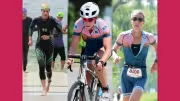
As a retina surgeon, Patrick Staropoli ’12 fixes “anything that goes wrong inside the eye.” As a racer in NASCAR’s O’Reilly Auto Parts Series, he has to ignore what his eyes tell him and drive 180-plus miles per hour. Those skills are intertwined. (This interview has been edited for length and clarity.)
What skills do you need to both drive a race car and perform surgery?
In racing, we say smooth is fast. You want to be smooth with the steering wheel and with your inputs on the gas and brake. When we operate, it’s the same thing. In retina surgery, you have two pedals—for the microscope and the vitrector, a small instrument that we use to fix retinas. How smooth you are on those pedals determines how well your surgery goes.
What’s your best “I wrecked that guy on purpose” story?
I was 15, racing a short track in Florida with one of my now-best friends, Drew Brannon. I led the entire race, and with two laps to go, he did a “bump and run.” That’s when the car behind you rolls into your bumper, they pick your back tires up off the ground, and you don’t crash, but you slide up the track just enough for that car to get by. I tried to pull the same move on him, and he ended up spinning out. I won the race, then they disqualified me and him for driving too rough.
Race car driving is about managing information. What’s that like in real time?
The faster you go, the faster your processing speed has to be. Your crew chief is talking to you about the car. Your spotter is in your ear telling you where the other cars are. You’re trying to listen, focus on what you’re doing, process it, and then give them feedback.
Your philosophy is to drive deep into a corner, and if you hit the wall, you hit the wall. A normal person might hear that and think, “What is the matter with you?”
You just have to unplug your amygdala. You have to have no fear. If you stay five or six feet off the wall your whole career, you’re never going to make speed.