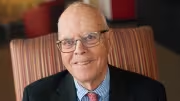
Among the Nobel laureates announced this week were two Harvard alumni: biochemist Karl Deisseroth ’92 shared the Nobel Prize in Physiology and Medicine, and human rights jurist Navanethem “Navi” Pillay, L.L.M. ’82, S.J.D. ’88, won the Nobel Peace Prize.
Deisseroth is a Stanford professor whose work helped launch the scientific field of optogenetics, which uses light to control the activity of individual nerve cells in a living brain. The technique allows scientists to study neural networks with minute precision, mapping out the specific cells and circuits that give rise to different behaviors, emotions, and brain functions. Over the past two decades, this technology has transformed basic neuroscientific research—literally illuminating the brain’s inner workings—and opened up new possibilities for treating a wide range of neurological and psychiatric disorders, including Parkinson’s disease, Alzheimer’s disease, schizophrenia, and depression.
“Optogenetics has fundamentally altered our understanding of the brain,” the Nobel Committee wrote in its announcement.
Deisseroth shared the Nobel Prize with two German scientists, Georg Nagel and Peter Hegermann—together the three are considered the fathers of optogenetics. Working together at the Max Planck Institute in the early 2000s, Nagel and Hegermann discovered a protein in a single-celled green alga that responded to blue light by opening a channel that allowed charged ions into the cells, creating an electrical impulse. The researchers named the protein “channelrhodopsin,” and they found that whatever cell they implanted it into became light-sensitive. Later, Deisseroth introduced the gene for channelrhodopsin into the nerve cells of living rodents, creating a “switch” that allowed scientists to turn neurons on and off using pulses of light.
At Stanford, Deisseroth teaches in the departments of bioengineering and of psychiatry and behavioral sciences. He is also a practicing psychiatrist and a Howard Hughes Medical Institute investigator. As a Harvard undergraduate, he concentrated in biochemical sciences, although when he arrived on campus at 16, he initially planned to study creative writing. He is scheduled to return to the University next March to speak at an event marking the 100th anniversary of the biochemical sciences tutorial program.
In an interview with Boston’s WBUR-FM after the prize was announced, Deisseroth explained the power of optogenetics, which scientists have used to trace the brain circuits involved in memory formation, pain sensations, and reward responses. In people with retinitis pigmentosa, a neurodegenerative disease that causes blindness, the technique is being tested as a way to restore sight. “What optogenetics does is it gives us the tools to pierce through that intricacy” inside the brain, he told WBUR. “Optogenetics is fast. Optogenetics is precise, just like the brain…As a psychiatrist, it's so exciting to look at this and think, ‘Oh, this is a way we can come to a deeper understanding of ourselves.’”
Pillay’s prize is more controversial. Currently a judge on the International Court of Justice (ICJ), she chaired the United Nations commission that in 2025 concluded that Israel was guilty of committing genocide in Gaza. On Friday, Israeli officials strongly condemned the decision to award her the Peace Prize, calling it “the grotesque weaponization of an award to legitimize anti-Israel hatred and prejudice.”
In its announcement, the Nobel Committee praised Pillay’s “commitment to universal legal principles and her firm moral compass” as “constants in a long career.” Raised in Durban, South Africa, in a family of Indian Tamil descent, she joined the anti-apartheid movement and as a young lawyer defended Nelson Mandela and other opponents of the regime. Her work helped expose the torture and poor prison conditions of the country’s political detainees.
She arrived at Harvard midway through her 28-year career as a lawyer and became the first South African to receive a doctorate from Harvard Law School, where she studied human rights and international law.
Pillay has been a judge for more than three decades. In 1995 she was appointed to the High Court of South Africa—the first woman of color to hold that position—and soon after that to the International Criminal Tribunal for Rwanda, which was formed to adjudicate the crimes committed during that country’s 1994 genocide. She served two terms on the court and was influential in the trial of Jean-Paul Akayesu, a Rwandan mayor accused of inciting fellow Hutus to murder, rape, and torture thousands of Tutsis. Akayesu became the first person convicted of genocide in an international court, and the case was the first to establish rape and sexual violence as weapons of war. In its announcement, the Nobel Committee also noted a separate legal breakthrough in that same case: “For the first time, a defendant faced charges of incitement to commit genocide purely on the basis of spreading propaganda.”
Pillay later served as the United Nations High Commissioner for Human Rights, and as a current judge on the ICJ, she is hearing a case in which Myanmar stands accused of genocide against the Rohingya ethnic minority.
In its announcement, the Nobel Committee described a system of international law facing “tremendous pressure,” with its institutions under attack. “We see a shift towards power politics at the expense of legal frameworks and global respect for law and justice.” In awarding the prize to Pillay, the committee wrote, its intent is “to remind the world that the rule of law—national and international—underpins the system we have set up to ensure peace and resolve conflicts non-violently. Peace requires justice.”