Eminent scholars of the social sciences gathered at Harvard in April 2010 to identify what they believed to be the hardest and most important problems in their disciplines. But that was just the beginning of the conversation: the event organizers created an online discussion page, as well as discussions on Facebook, and invited the public to rank the problems and to submit their own if they felt a truly important problem was missing from the list. The results were surprising.
- Read coverage of the initial symposium from the July-August 2010 issue, and a more detailed account that appeared online.
- Find out how public opinion differed from the scholars' opinions. Scroll down for a chart listing some of the problems and showing how they ranked on various scales.
- Visit the official "Hard Problems" page, with video of the scholars' talks and a summary of the poll results, on the Faculty of Arts and Sciences social-science division website.
- Read a Nature article about the "Hard Problems" project.
- Read about a parallel effort by the National Science Foundation.
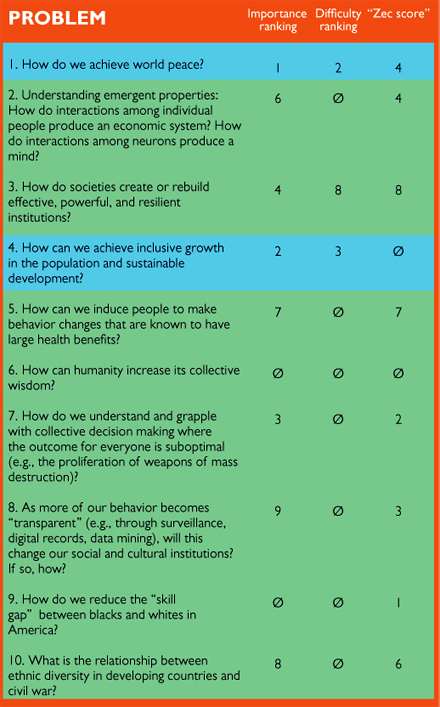
Problems that appear in green were proposed by scholars in the social sciences at the April 2010 Harvard symposium. Problems that appear in blue were proposed by the public on Facebook. The public was asked to rank the problems on a scale of 1 to 6 in terms of importance, and 1 to 6 in terms of difficulty. The scores were parsed in different ways; what’s below is the “Super Top Ten” of the problems that most consistently scored high. The three columns show where each problem ranked in terms of sheer importance, sheer difficulty, and the “Zec score,” in which extreme difficulty counts against a problem in deciding which problems to tackle first. (See the article text for a fuller explanation.) A Ø sign means the problem did not rank in the top 10 on this scale.