Daniel Radcliffe isn’t a big fashion name, necessarily. But the actor once told Chloe Chapin, Ph.D. ’23, a story that cracked open the way she thought about men’s clothing.
Chapin, who spent years as a freelance costume designer in New York working on Broadway musicals, operas, fashion shows, and more, was on the production team for a revival of the play Equus, Radcliffe’s 2008 Broadway debut.
“During the opening night party, he was wearing this beautiful, really dark blue tuxedo,” Chapin remembers. As they chatted, Radcliffe told Chapin about how, thanks to King Edward VIII of England, midnight blue tuxes became stand-ins for black tie in films and photographs in the early twentieth century.
“He was the first widely photographed royal, and he found that black suits didn’t photograph well,” Chapin says. “It’s a trick that film designers now use. In a lot of the James Bond movies, he’s wearing a midnight blue tuxedo. It reads black on camera.”
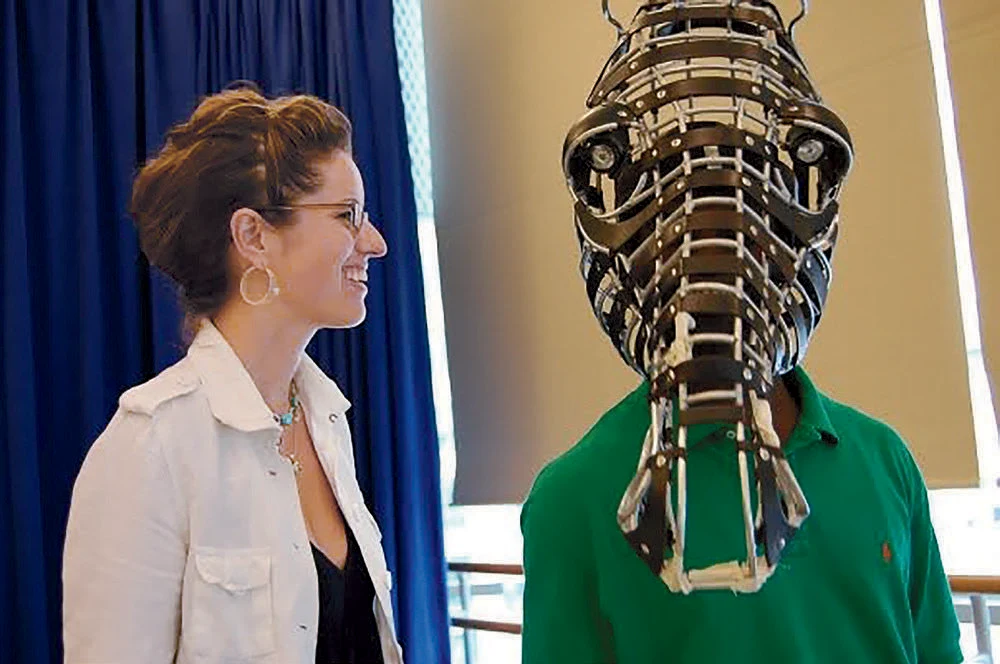
“I thought that was such a fun, sexy story,” she remembers. “So I started researching the history of tuxedos.”
Chapin always loved the research aspect of her costuming work—so much so that, in 2016, she started her Ph.D. in American studies at Harvard, graduating in 2023 and honing a particular expertise in menswear. She now serves as the assistant director of course development at the Bok Center for Teaching and Learning, as well as a lecturer in the history department, where she has taught seminars on applying research techniques to browsing artifacts and museum collections.
Her years behind the scenes of New York stages, doing everything from sourcing textiles to helping Melissa Etheridge pick out leather pants to wear in the musical American Idiot, have added a lived-in, tactile dimension to her work as a fashion historian.
“I loved that she could sit and tell me about sewing the shoulder onto some sixteenth-century costume, and understand what that meant in a broader sense,” says Chapin’s thesis adviser Jennifer Roberts, Faust professor of the humanities and a professor of American and contemporary art. Chapin’s expertise in both hemming trousers and writing footnotes about them—her ability to marry a theoretical understanding of fashion history with a practical one—makes the case for a field of study that hasn’t typically been taken seriously by academics.
“When Chloe walked into my office, it was a thrill, because here was a student that I felt could do this difficult work of changing the way the academy thinks,” Roberts says.
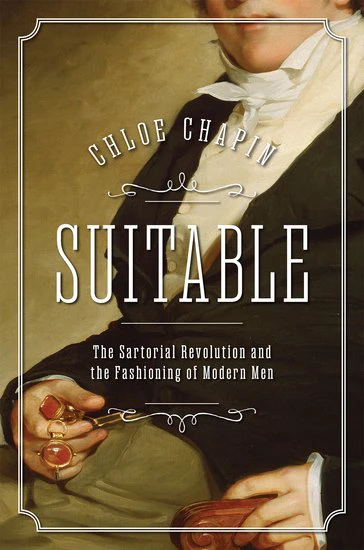 Chapin’s first book, Suitable: The Sartorial Revolution and the Fashioning of Modern Men, was published by Oxford University Press in June. Suitable, which grew out of her Harvard Ph.D. thesis, goes beyond tuxedos to explore how the dark suit and necktie became the standard work outfit for powerful men—so ubiquitous in its uniformity that it is, from a fashion perspective, all but invisible.
“The scope of the book is the American Revolution to the Civil War, this roughly 75-year period in which men’s dress went from colorful and varied to plain and uniform,” Chapin says. “I call it the shift from peacocks to penguins.”
Suitable details how, unlike in women’s fashion, conformity evolved among men to be the expectation—starting, in part, as a rebuke of the ostentatiousness of European court dress in pre-revolutionary America. This had a range of lasting effects. Fashion itself came to be perceived as a more frivolous domain, and uniformity among men became a means of excluding those who didn’t look and dress a certain way from the upper echelons of authority.
Even now, any deviation from the black suit norm is liable to be taken as a faux pas, disrespectful, or worse. When U.S. President Barack Obama, J.D. ’91, wore a tan suit to a press conference in 2014, it was a top news story for several days; pundit Lou Dobbs called it “shocking to a lot of people.”
“It’s much more common for men to want to dress like every other man,” Chapin says. “Men always have stories of arriving to a dinner and being the only one in a tie, rushing to the bathroom and stuffing it in their pocket. Men and women have a lot of feelings about their clothes. It just shows up in different ways.”
Across decades of outfitting men for the stage, Chapin got to see those feelings up close. Growing up in Santa Cruz, California, she did a variety of backstage crew jobs for area productions, including as a dresser for the local Shakespeare festival.
“I learned how to sew because I had to fix stuff when it broke,” she says. As an undergraduate at Cornish College of the Arts in Seattle, she worked in the costume shop, becoming an ace at conquering stretch fabrics thanks to the school’s large dance program.
“It was the ’90s, so that ribbed ‘boingy’ fabric, whatever it’s called, and crushed velvet were very popular,” she says. “If you can sew that, you can do literally anything.”
After earning an MFA in costume design from the Yale School of Drama, Chapin moved to New York, taking gigs dressing actors, singers, and dancers, but also putting together budgets, shopping, and making sure a show’s clothing aesthetic was cohesive and accurate. She loved working on rock musicals, including American Idiot and Passing Strange. For the 2009 Broadway revival of Hair, she had to help source period-appropriate boots that wouldn’t fall apart during the musical’s punishing, stomping dance numbers.
In New England, she’s worked on local productions, too. Sara Brown, an associate professor and set designer at MIT who has collaborated with Chapin on campus shows, says Chapin understands the potency of clothes as storytelling devices and set pieces.
“She is the kind of designer who gets excited about having input in terms of what the final product is going to be,” Brown says, recalling a jacket Chapin made from a floral print bedspread for a key moment in a student dance piece.
Throughout her costuming work, Chapin witnessed how clothes changed the way men carried and perceived themselves. “Onstage I’ve watched men puff out their chests, show off their calves, and gesture with their wrists in response to their clothing,” she writes in Suitable. “I’ve seen how wearing a dress, a servant’s uniform, or a crown can change how a man behaves around other men, even in a world of make-believe.”
In New York, Chapin taught courses at the Fashion Institute of Technology on fashion history and twentieth-century style and realized there was a frustrating dearth of books about men’s clothing. The seed of the idea that would grow, eventually, into Suitable came in 2012, when Chapin was researching costumes for a production of the Verdi opera La Traviata, which opens with the entire chorus onstage in formal dresswear for a ball. Typically, La Traviata is set in the late nineteenth century, by which time men were wearing tails and white vests for formal occasions. But this production was set a few decades earlier, before black tie took over, and men’s fashion was more varied.
“Suddenly the standard for men’s formalwear became a complete mystery,” she writes in the book. “No men were wearing black and white in 1800—but by 1850, all of them were. And they’re wearing it still, 200 years later.”
Though she had a toe in research and teaching throughout her costuming career, Chapin’s path into academia was far from the conventional one.
“She had very little official academic experience,” Roberts says. “She hadn’t been already trained in research and writing papers. But Chloe can look at a pair of pants and really understand all of the crises and decisions that had to go into putting a seam here instead of there.”
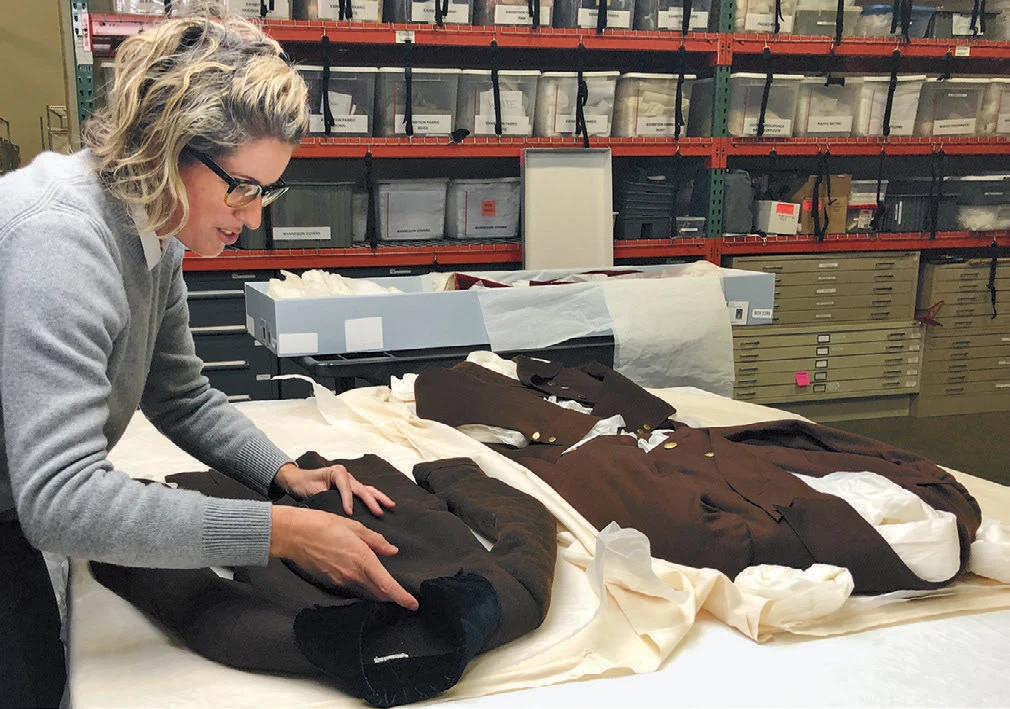
For Chapin, her scholarly drive evolved from those practical concerns. “People always say, ‘As a historian, how did you discover suits?’” she says. “And I’m always like, ‘No, it was the other way around. I was a suits person who discovered history.’”
Roberts thinks Chapin could be uniquely positioned to get fashion taken more seriously within the research community. “You could go to the Fashion Institute of Technology and learn all about the history of fashion, but if you walk onto the Harvard campus, it’s very hard to find anyone who’s talking about that,” Roberts says. “This is someone who could really make a difference in the way people think about this topic now.”
For her next project, Chapin is considering taking on the history of clothing and fashion dating back to the Paleolithic era—interrogating, along the way, why something so fundamental to the human condition has been so overlooked in academic spaces. “It’s older than religion, it’s older than art, it’s older than language,” she says.