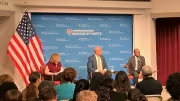
Last week, scholars, policymakers, and political leaders convened at the Harvard Kennedy School (HKS) to discuss Venezuela’s future following the capture on January 3 of Venezuelan President Nicolás Maduro—who had been in power since 2013—by U.S. forces.
The conversation, moderated by Institute of Politics interim co-director Ned Price, who previously served as a senior advisor to Secretary of State Antony Blinken, brought together four panelists: Freddy Guevara, a Venezuelan opposition leader and a visiting fellow at the Ash Center for Democratic Governance and Innovation; Ricardo Hausmann, Hariri professor of the practice of international political economy, who also leads the HKS Growth Lab; Rebecca Bill Chavez, the former deputy assistant secretary of defense for Western Hemisphere affairs; and Juan Gonzalez, the former senior director for the Western Hemisphere at the National Security Council.
The panelists argued that Maduro’s removal creates a historic opening for Venezuela, but that meaningful democratic reform (including rebuilding rule‑of‑law institutions, restoring constitutional order, and empowering Venezuelans themselves) must come before sustainable economic recovery and foreign investment can take root.
Venezuelans React to Maduro’s Removal
Guevara, who spent several years as a political prisoner in Venezuela before fleeing into exile, did not mince words in describing the events of early January, when Maduro and his wife were captured in a U.S. military raid and brought to New York to face criminal charges of drug trafficking and “narco-terrorism.” Some have questioned whether the Trump administration had the authority to make the raid without Congressional approval.
“I know this may sound contradictory, but the truth is simple: Venezuelans are happy and relieved that Nicolás Maduro is no longer free and is in prison,” Guevara said. While many in the United States and around the world have serious—and justifiable—concerns about how Maduro was captured, he added, the outcome of the U.S. operation is one many Venezuelans have spent years fighting for.
“This is about real lives: torture, imprisonment, exile, families broken apart, a country held hostage for more than 25 years,” Guevara explained. “We wanted a democratic transition. We wanted justice through institutions.” But those institutions—from elections to negotiations to international mediation through bodies including the United Nations, the International Criminal Court, and the Organization of American States—repeatedly failed.
Still, the future of Venezuela remains uncertain, from the Trump administration’s role in directing the current Venezuelan government’s actions to the extent that Maduro’s influence has (or has not) waned. Hausmann followed Guevara’s remarks by underscoring how much of Venezuela remains under a “chavista system”: a governing framework named after former dictator Hugo Chávez, characterized by strong executive power and state control over resources, especially oil.
“Right now, Venezuelans have not been empowered,” Hausmann said. “The colectivos are [still] in the streets,” he said.
Colectivos in Venezeula are pro-government armed civilian groups, often motorcycle gangs, that act as enforcers for the ruling regime. Up until January, they supported former President Maduro by suppressing protests and engaging in criminal activities.
Hausmann pointed towards other figures of corrupt power who still remain in place: “Diosdado Cabello controls the police. Vladimir Padrino López controls the armed forces,” he said. “The government today is essentially the same one we had before Maduro left.”
Economic Recovery and Democratic Reform
Looking to Venezuela’s future, Hausmann stressed that genuine democratic reform will be necessary for economic recovery.
“There’s a belief, especially from President Trump, that first we recover the economy and oil sector, and democracy can come later,” he said, but it is simply “not feasible to do it that way.”
Under Venezuela’s current hydrocarbons law, Hausmann explained, all production must be carried out by Petróleos de Venezuela, S.A. (PDVSA), the state-owned oil and gas company, which has become insolvent and faces multiple lawsuits. Any joint ventures by foreign or private partners, he continued, require 51 percent of state ownership and face a “tax [that] is gigantic,” deterring any serious investment by major international oil companies and even many Venezuelan private firms.
Compounding the problem, PDVSA’s revenues can be seized by its creditors at any moment, Hausmann said. The country itself is in default, and its distorted currency system raises basic questions among potential investors about whether there is a reliable, consistent way to convert Venezuelan bolívars into dollars or other hard currencies.
Venezuela has multiple official exchange rates, strict government controls on who can buy foreign currency, and a long history of hyperinflation, so investors cannot be sure how much their profits would actually be worth if they tried to move them out of the country.
Amidst ongoing political chaos—a national assembly whose legitimacy few recognize, the presence of those armed civilian groups in the streets, and the fact that a number of high-ranking officials from the Maduro regime have, so far, retained their positions—any reform imposed “under the barrel of the gun” would lack credibility with a future democratic legislature, Hausmann said. Venezuela must return to constitutional rule first, he added, before it can undertake sustainable economic recovery.