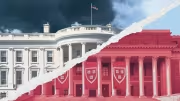
Who owns Harvard courses? Professors? The University? As the potential audience grows—enabled by new technology—so may the money at stake. Some universities have asserted ownership of courses. Harvard, instead, has revised its policies on the outside activities of faculty members to ensure that “Harvard students will have special access to an education distinctive to the University they attend.”
The issue drew public attention when law professor Arthur Miller taped lectures for on-line Concord University of Law. Miller, well-known for his former PBS show, Miller’s Court, has been professing law to the public for years on videotape, so the distinction between his former activity and the new one—arguably prohibited under the old rules against teaching at another institution—was fuzzy. The new rules explicitly state that it is permissible to distribute materials (video, audio, text) electronically if the materials “do not constitute a substantial portion of a course”; are “produced without a substantial University contribution”; and are distributed on a “non-exclusive basis.” “It’s not a question of prohibition,” says associate provost Dennis Thompson, chair of the policy committee, “but of permission. The aim here is not to discourage faculty members from disseminating knowledge freely. That’s our vocation...and the more the Internet can help in that, the better.” Faculty members have obligations to the Harvard community of their colleagues and students and to the University, reasons the policy, which sets a limit on total outside professional effort of 20 percent, leaving to the faculties the interpretation of this standard. Faculty may continue to teach at other institutions in the summer and during sabbaticals, but not for redistribution in electronic form.