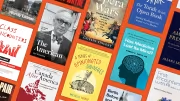
Invasion of the Body: Revolutions in Surgery, by Nicholas L. Tilney, Moore Distinguished Professor of surgery (Harvard, $29.95). A surgeon distinguishes a knife, with its dangerous connotations, from a scalpel and its healing potential. A leading practitioner of the latter skill documents its evolution, extent (85,000 elective procedures in the United States daily), and coming challenges.
America’s Climate Problem: The Way Forward, by Robert Repetto ’59, Ph.D. ’68 (Earthscan, $29.95). An environmental economist, now at the United Nations Foundation, says American action is crucial to solving Earth’s greatest challenge—and can be consistent with growth and high living standards. Foreword by Timothy E. Wirth ’61, Ed.M. ’65, president of the foundation.
Tamil Love Poetry, by Martha Ann Selby, RI ’05 (Columbia, $$27.50 paper, $84.50 cloth). A meticulous translation and interpretation of a 500-poem work from the early third century, the subject of the author’s Radcliffe Institute fellowship. From the section on “Jealous Quarreling”: “That man from the place/where white reed flowers wave over the bushes/like cranes streaking through the sky—/because he wants fresh women,/my ignorant heart is wretched.”
Constitutional Originalism: A Debate, by Robert W. Bennett ’62, LL.B. ’65, and Lawrence B. Solum, J.D. ’84 (Cornell, $29.95). In a back-and-forth deliberately drained of “sound and fury,” Bennett, of Northwestern’s law school, and Solum, of the University of Illinois College of Law, plumb the philosophy of language and problems in textual interpretation to shed light on contending claims.
The Inner Life of Empires: An Eighteenth-Century History, by Emma Rothschild, Knowles professor of history (Princeton, $35). The Enlightenment and global British Empire as experienced through the 11 Scottish Johnstone siblings, a remarkable family—whose friends included Adam Smith and David Hume.
Religion in Human Evolution: From the Paleolithic to the Axial Age, by Robert N. Bellah ’48, Ph.D. ’55 (Harvard, $39.95). An enormous inquiry, by Berkeley’s Elliott professor of sociology emeritus (co-author of Habits of the Heart), into the biological past to explore what kinds of lives people determined were worth living. Bellah interprets common elements of the cultural evolution of religion in ancient Israel, Greece, China, and India.
A Contest for Supremacy, by Aaron L. Friedberg (Norton, $27.95). The author, of Princeton’s Woodrow Wilson School, is, as his title suggests, anxious about the stakes, strategies, and outcomes as China and the United States (from the subtitle) “struggle for mastery in Asia.”
Dignity, by Donna Hicks (Yale, $27.50). An associate of Harvard’s Weatherhead Center for International Affairs draws on her experience in working with warring parties around the world to home in on the essential ingredient in resolving conflicts. Foreword by Archbishop of Cape Town emeritus Desmond Tutu, LL.D. ’79.
Breaking Up with God: A Love Story, by Sarah Sentilles, M.Div. ’01, Th.D. ’08 (HarperOne, $22.99). En route to her ordination as an Episcopal priest, the author lost her faith. A personal account of how that happened, and felt.
The New Global Rulers: The Privatization of Regulation in the World Economy, by Tim Büthe ’95 and Walter Mattli (Princeton, $27.95). International business organizations and commerce have outstripped the reach and expertise of governments, so the standards for accounting and for products traded have been delegated to global private regulators. A Duke political scientist (Büthe) and University of Oxford political economist (Mattli) find that the process remains political.
Numerical Relativity: Solving Einstein’s Equations on the Computer, by Thomas W. Baumgarte and Stuart L. Shapiro ’69 (Cambridge, $90). Astrophysicists can’t toy with black holes or neutron stars in the lab. They simulate them. Baumgarte, of Bowdoin College, and Shapiro, of the University of Illinois at Urbana-Champaign (where Baumgarte also works as an adjunct)—a sort of binary-star pair who both held Guggenheim fellowships—provide a text to the field.
Field Notes on Science and Nature, edited by Michael R. Canfield, lecturer on organismic and evolutionary biology (Harvard, $27.95). Excerpts from the field notebooks of great naturalists: George B. Schaller (The Serengeti Lion), Bernd Heinrich (Bumblebee Economics), and others. Foreword by Pellegrino University Professor emeritus E. O. Wilson. The illustrations may encourage children to explore nature, and tourists to keep journals.