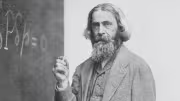
The late Arthur M. Schlesinger Jr. ’38, JF ’43, LL.D. ’01—historian, presidential adviser, Democratic Party leader—wrote a lot (President Neil L. Rudenstine said he covered “a cast of characters as capacious as Aida’s without the elephants”). It is no surprise that he was a prolific correspondent. Sons Andrew ’70 and Stephen ’64, LL.B. ’68, have now edited The Letters of Arthur Schlesinger Jr. (Random House, $35). From their introduction about this “inveterate letter writer” and his myriad correspondents:
For the most part, what brought him together with these individuals were his political beliefs. The abiding theme of his correspondence over a 60-year period is his preoccupation with liberalism and its prospects. He was always in some way promoting and advancing the liberal agenda; it was his mission, purpose, and justification.
What did the liberal credo mean to Schlesinger? As he wrote in his much acclaimed book, The Vital Center, published in 1949: “The job of liberalism [is] to devote itself to the maintenance of individual liberties and to the democratic control of economic life—and to brook no compromise, at home or abroad, on either of these two central tenets.” For him, liberalism was “a fighting faith.” In The Cycles of American History (1986) he noted that liberals do not see the unfettered marketplace as an “infinitely sensitive, frictionless, impartial, self-equilibrating mechanism.” Instead, he wrote, “The liberal believes that the mitigation of [economic] problems will require a renewal of affirmative government to redress the market’s distortion and compensate for its failures—but affirmative government chastened and reformed, one must hope, by stringent review of the excesses and errors of [past] centuries.”
On September 14, 1960, Senator John F. Kennedy, accepting the New York Liberal Party’s presidential nomination, proclaimed his liberalism in words Schlesinger helped craft, saying: “If, by a ‘Liberal’ they mean someone who looks ahead and not behind, someone who welcomes new ideas without rigid reactions, someone who cares about the welfare of the people—their health, their housing, their schools, their jobs, their civil rights, and their civil liberties—someone who believes we can break through the stalemate and suspicions that grip us in our policies abroad, if that is what they mean by a ‘Liberal,’ then I am proud to say I’m a ‘Liberal.’ ”
This is what liberalism meant to Schlesinger.