
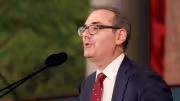
Harvard Law School professor of practice Alan Jenkins ’85, J.D. ’89, first mentions his hometown (Great Neck, Long Island), but quickly moves on to his grandparents’. One pair moved to the United States from the Bahamas, the other from Georgia to Detroit during the Great Migration. “I’m kind of the product of those migrations in search of opportunity—economic opportunity and civil rights.” Entering the College, Jenkins knew he wanted to pursue “something social-justice oriented”—and continue filmmaking. In high school, he had shot movies and edited film by hand. His crowning achievement: a kung-fu feature he made with friends. (He still practices that martial art.) As an undergraduate he resurrected the Harvard Radcliffe Filmmaking Club and even considered a career in film before deciding on law. He spent a year at the ACLU before attending the Law School, where he edited The Civil Rights-Civil Liberties Law Review and met his wife, Kirsten Levingston, J.D. ’90. After a Supreme Court clerkship with Justice Harry Blackmun ’29, LL.B. ’32, LL.D. ’94, five years at the NAACP Legal Defense Fund, and a stint at the Justice Department, he and Levingston left Washington: “We often say we were the first people to move to New York City to slow down our lifestyle.” As director of human rights at the Ford Foundation, he led grant-making to groups focused on rights issues. Finding that many social-justice organizations struggled to share their ideas with the public, he left to co-found The Opportunity Agenda, a communications nonprofit. “My parents freaked out: ‘You’re leaving your job for what reason?’” He led the group for 13 years. Now, he’s back in Cambridge, teaching about race and the law, communication, and social justice. “For those who are trying to pursue a more fair and just society, I’m hoping to give them what took me 25 years to learn.”
Harvard Law School professor Alan Jenkins
A brief look at a Harvard Law School professor's long journey

Alan Jenkins | Photograph by Jim Harrison
You might also like

How CNN’s Abby Phillip Referees Political Debates
The Harvard graduate’s roundtable talk show touches on hot button issues from religion to sex.

Why Men Have Worn the Same Black Suits for 200 Years
Chloe Chapin trains her Broadway costume designer’s eye on the history of men’s fashion.
Meet the Harvard Alumni Association’s New President
David Battat promotes alumni engagement.
Most popular


Explore More From Current Issue

A roundup of University news from the summer of 2026

A College student’s attempt to recapture the romanticism of the workplace.

In 2004, a frenzy spread across Harvard Yard in days. Four billion users later, we are only just catching up.