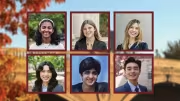
Three Harvard alumni were among the nominees announced on Tuesday as finalists for the 2022 National Book Awards. In the nonfiction category, Princeton historian Imani Perry, J.D.-Ph.D.’00, was nominated for South to America: A Journey Below the Mason-Dixon to Understand the Soul of a Nation, which mixes memoir, travelogue, and literary history. Born in Alabama, Perry moved north as a child and returns to the South to study the fractures over history, race, and justice that are at the heart not only of that region, but of the nation: “To be an American is to be infused with the plantation South, with its Black vernacular, its insurgency,” she writes, “and also its brutal masculinity, its worship of Whiteness, its expulsion and its massacres, its self-defeating stinginess and unapologetic pride.”
Poet John Keene ’87, a former MacArthur Foundation Fellow (the popularly named “genius” grants) and a founding member at Harvard of the Dark Room Collective, was nominated for Punks: New & Selected Poems, a volume that covers several decades of his writing, including previously unpublished work. Evoking both queer and African American experiences, it weaves together narratives of loss, lust, love, and family. “A languorous and nervy book,” declared reviewer Ken Chen in The Nation, “Punks tells a social history of desire, at once surreptitious and brazen. Signaling the return of the social, its poems emanate a radiant kindness.”
And translator Damion Searls ’92, was nominated for A New Name: Septology VI-VII, a novel by the Norwegian writer Jon Fosse. The final installment of Fosse’s Septology sequence (Searls was the translator for all), the new book follows two dopplegängers: one an aging widower, the other hospitalized with alcoholism—both painters named Asle living nearly indistinguishable lives on the coast of Norway. An examination of art-making, identity, friendship, and faith, the book offers “a transcendent exploration of the human condition and a radically ‘other’ reading experience—incantatory, hypnotic, and utterly unique,” according to a description by the Booker Prizes committee (for which the novel was also shortlisted). A review in The Guardian of an earlier installment of the series described it as “nimbly and hauntingly translated” by Searls.