As a young harpsichordist, Martin Pearlman first saw musicians performing on period instruments in Amsterdam. Intrigued, he thought he’d try to replicate a similar concert in America. “I was curious what would happen if I got the very few people who could play well on those instruments at the time together,” he says. “There were not even a lot of recordings then, and a lot of what we learned about the playing styles came from books.” Ultimately, he put together four concerts for a 1973-74 season, and “It turned out to be so popular with audiences that I decided to do it again.”
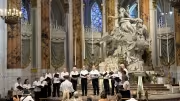
He’s been doing it ever since. The group he founded (he is still the music director and conductor) is Boston Baroque, now celebrating its fiftieth year this season. Grounded in the baroque style (Western music from about 1600 to 1750), the 20-to-40-member ensemble, using about 15 instruments, also performs later classical works and some opera. The group has appeared across the country and abroad and released landmark recordings, earning six Grammy Award nominations. “The period we cover is at least as large as what a symphony orchestra covers, over 200 years,” he says. The great music composed then “goes deeply into the human experience. It speaks to people forever.” This December, Boston Baroque presents George Frideric Handel’s Messiah, followed by a New Year’s Eve celebration concert featuring Handel’s “Let the Bright Seraphim” and “Eternal Source of Light Devine,” along with works by Johann Sebastian Bach, Heinrich Biber, and William Boyce. (Check the website for details on ticketing and locations.) March brings a performance of Antonio Vivaldi’s The Four Seasons. The anniversary celebrations conclude in April with a new production of Wolfgang Amadeus Mozart’s Don Giovanni. How the orchestra and its reputation and popularity have grown over five decades still sometimes surprises Pearlman. “I just wanted to do some concerts,” he says of his youthful aspirations. “I wasn’t intending to start an institution.”