Fans heard the clop-clop first. Six times a day, a horse climbed a series of ramps up to a 40-foot platform. The emcee asked for silence, his voice booming a half-mile down New Jersey’s Atlantic City pier. A young woman in a bathing suit mounted the horse—harness but no saddle—and waited. Sometimes, the horse took 20 seconds to advance; sometimes, 20 minutes passed. The horse approached the edge, placed its two front hooves onto the slanted platform, slid, and pushed off with its hind legs. The rider reared back, avoiding the horse’s head, and held on tight. Then: SPLASH! The eleven-foot-deep above-ground pool lost half of its water on impact. Horse and rider emerged victorious.
These peculiar diving horses served as the centerpiece of Atlantic City’s water circus for nearly 50 years. A veteran diver’s scrapbook, recently acquired by the Harvard Theatre Collection, allows viewers to imagine a day on the pier.
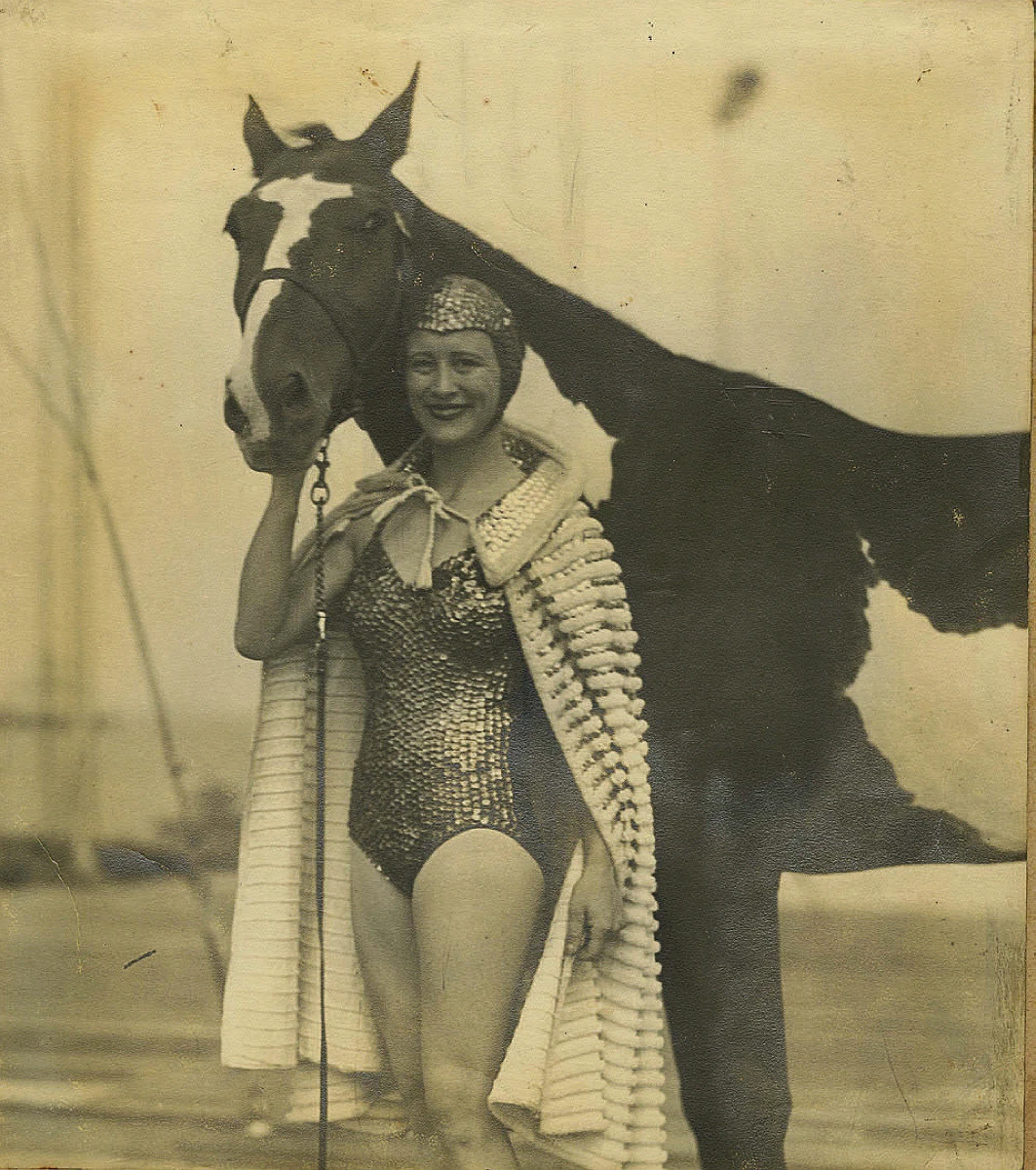
Elsa Rahr, the scrapbook’s creator, was born in Hamburg, Germany, and immigrated to the U.S. at age 18. She grew interested in the circus and signed up to be shot from a cannon. But she said she was “too light” and went “too far,” enduring constant bruising. Then, she met William Frank “Doc” Carver—a sharpshooter who performed with Buffalo Bill. Carver pioneered diving horses, supposedly inspired by a bridge collapsing while he was riding over it. He and his daughter Lorena (also a diver) convinced Rahr to join the troupe.
Rahr’s beauty was part of her appeal. A 1936 newspaper account of her act describes her as “hazel-eyed and pretty.” Such marketing may have played into the choice to have riders (all female) not wear goggles or helmets. Rahr said she broke her nose multiple times, but when asked about it, she did not seem to mind. She went blind later in life, perhaps as a complication of her act. (Another performer went blind after entering the water with her eyes open on a botched dive.)
Alongside photos of her act and newspaper clippings, Rahr collected photographs of her fellow performers. There were water skiers and dancers, tiger-tamers and acrobats. She married Rupert Corri, a comic actor, and the pair later staged (horse-free) shows together. An interior design certificate in Rahr’s name hints at a later, and safer, career.
Two pages from Rahr’s scrapbook will be on display at Houghton Library this summer in the exhibit All Stars: The Sensational History of Athletics as Entertainment. “Before the rise of professional sports, there were athletes, but you couldn’t really get paid to be a professional sportsperson,” says curator Matthew Wittmann. “People had these incredible physical skills, but they used them to entertain people, not to compete.” The exhibit is organized around physical and mental attributes. Rahr’s, of course, is “daring.”