The Year Harvard Scrapped Maid Service

Until the 1950s, professionals cleaned up after students in the dorms.

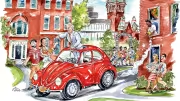
A chaotic scene in a messy room with people engaging in various activities, some cleaning.

Illustration by Mark Steele

For more than two centuries into the College’s existence, professional maids tidied up after the Harvard boys. Known on campus as “goodies,” “sweeps,” and “biddies,” the crew of female workers scrubbed floors, made beds, and dusted dorm rooms. They also fought for better working conditions. A campus union formed in 1936 won the maids a six-day workweek and 41 cents an hour. By 1952, they were working 20 hours a week at 96 cents an hour, “as well off as any other college maids in the country,” a Crimson story noted. But within a few years, as the University began phasing out deluxe dorm service, replacing it with a student porter system, a precursor to Dorm Crew.

The shift came at a time of post-World War II budget measures—and as maids were reportedly requesting another pay hike. On campus, according to another Crimson story, reactions to the announced change ranged. Some students were nonchalant. One applauded the addition of needed student jobs, while another thought that hiring some students to clean up after others could foster an undemocratic caste system. A proctor voiced concern that eliminating the maids was the College’s answer to their request for higher wage. At least one student archly lamented the loss: “One of the best things of living at Harvard is the elimination of that menial task of bed-making. The one last remnant of gracious living is in serious proximity to death.”

Read more articles by Nell Porter-Brown
Related topics

You might also like

A Harvard President’s VW Beetle That Kept On Giving

Derek Bok donated his car for a good cause.

The Year a Beat Poet Squatted at Harvard

In 1954, Gregory Corso moved into Eliot House. How he stayed there is a literary legend.

Cambridge Once Fought Harvard’s DNA Research. Now There’s a Play About It.

A theatrical reenactment explores a 1976 clash between science and democracy.

Most popular

These Harvard Graduates Are Candidates for Sainthood

For advocacy and benevolence, three late alumni are reportedly in line for the Catholic Church’s highest honor.

How Philosophy at Harvard Saved Itself

As humanities shrink across higher education, one department is flourishing. Is its success a fluke, or a roadmap?

To Promote Healthy Habits in Patients, Start with the Doctors

Why Harvard Medical School is training physicians to think more like coaches

Explore More From Current Issue

Black and white portrait of a woman with medium-length hair, smiling softly.

The outgoing executive director and Harvard Business School graduate went from dancing The Nutcracker to growing a ballet company.

Collage of three photos of an athlete in a triathlon: one swimming, one cycling, one running, in sports attire.

The Harvard triathlete and coach says she helps normal people to “do extraordinary things.”

A girl in blue boots stands on a cliff, holding a leash attached to a glowing, digital dog.

Establishing legal responsibility for autonomous agents