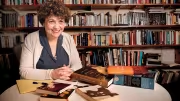
If Americans want to contain terrorism, we must not abandon our democratic values, says Louise Richardson, the departing executive dean of the Radcliffe Institute for Advanced Study (she becomes principal of the University of St. Andrews, in Scotland, in January). There is a false belief, she has written in What Terrorists Want, that democratic societies, because of the “freedoms granted citizens” are “peculiarly vulnerable to terrorism” and that those freedoms “therefore must be curtailed.”
This is wrong on principle, she said in a recent interview, but also for pragmatic reasons. Like declaring war, it not only rewards “the adversary’s action by demonstrating its power,” it undermines one of the best counterterrorist strategies known, which is to separate terrorists from the communities in which they operate. Terrorists understand this, she says. A message from an al Qaeda leader to a deputy in Iraq, for example, urged him to end beheadings not because they were immoral or gruesome, but because they were undermining support in the Muslim community. Likewise, the treatment of prisoners at Guantánamo is “an ethical and moral travesty that undermines our claim that we believe in democracy, that we believe in individual rights, when we so clearly deny due process to hundreds of people,” Richardson says. “We’re in a competition, if you like, with the extremists for the support of these moderate populations, and we have been losing that battle.” By overreacting, “we can do ourselves far more harm than terrorists can ever do to us.” (For more on Richardson’s alternative approach to containing terrorist threats, see the Web Extra[extra], “Counterterrorism and Democracy.”)