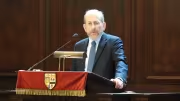
U.S. Army General David H. Petraeus, commanding officer of U.S. Central Command, spoke yesterday to a capacity crowd at the Harvard Kennedy School (HKS) at an event that honored Harvard's student veterans. U.S. Marine Corps veteran Maura Sullivan, a joint-degree student at HKS and Harvard Business School, noted in her introductory remarks that more than 1,200 Harvard alumni have given their lives in military service. She also called on the University to reinstate an on-campus ROTC program and to support the "Yellow Ribbon" program in the new GI Bill, which would help veterans attend Harvard.
A standing ovation welcomed Petraeus, who gave a detailed description of the “Anaconda” strategy—steps taken to pacify on-the-ground conditions in Iraq during the past two years. He explained, for example, the importance of "getting the big ideas right" before committing energies to policies or tactics. In Iraq, one such big idea was to have the troops live with and among the people, rather than barricaded in military compounds. ("You can't commute to the fight," he said.) Living in close proximity to Iraqi citizens helped build local trust for the military effort, and also helped identify the real enemy actors. He told of how he pressed his officers to take initiatives in the nation-building effort: "We met this morning with the council of sheiks," one reported to him. "Now I'm working on getting air conditioners into the mosque."
In Afghanistan, Petraeus explained, the big ideas and strategies will have to be adapted for the indigenous society and culture. Troops will not be moving into mountain villages to live alongside local residents; instead, they might camp on the edge of the village. He said that although he is optimistic about the long-term prospects in Afghanistan, in the short term, things may well get worse before they get better. In both Iraq and Afghanistan, he noted, the military strategy aims to build cooperative relationships with moderate local leaders, and puts emphasis on separating the "irreconcilables" (hardcore terrorists and extremists) from "reconcilables."
After the HKS talk, Petraeus attended and spoke at a dinner honoring the military veterans now studying at the University. He reminisced about his years at Princeton's Woodrow Wilson School of Public and International Affairs, where he earned a Ph.D. in international relations in 1987, and thanked the Harvard veterans "for your decision to push yourself intellectually. Leadership," he told them, "requires thoughtful, nuanced, out-of-the-box thinkers."
See here for the Harvard News Office report on the Petraeus talk.