The Early Retirees

The University has disclosed information on the staff members, by school, who were offered and who accepted its voluntary early-retirement incentive program.

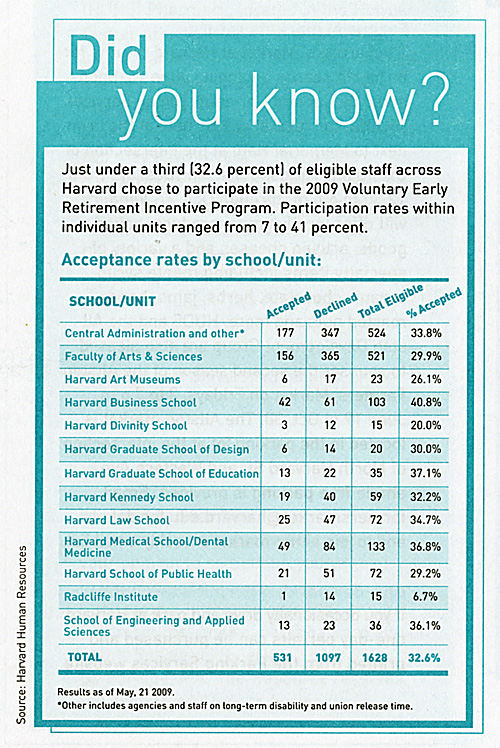
The University has disclosed how many staff members, by school, were offered and accepted the voluntary early-retirement incentive--for those 55 years and older, with 10 or more years of Harvard service--one of the principal cost-saving measures implemented so far. (For background, see here ). The offers were made in two waves, concluded in early May. In all, 531 of 1,628 eligible employees--32.6 percent-accepted.

This exhibit, with data from Harvard Human Resources, was published in the June 2009 issue of the Harvard Resource, the employee newspaper.
 

You might also like

Judge Vacates Trump Administration Limit on International Student Visas

Harvard was in a group of plaintiffs that filed suit against the rule in August.

Cancellations, Disruptions as Harvard Graduate Student Strike Enters Second Week

Some faculty complain about the protests’ effect on students.

As Union Protests Continue, Stephen Colbert and Yo-Yo Ma Event at Harvard Cut Short

A conversation between the comedian and the celebrated cellist was interrupted by a fire alarm in Sanders Theatre.

Most popular

New Names Proposed for Harvard Extension School Degrees

Long pushed for, the changes would be part of a broader rebranding for the Division of Continuing Education.

To Promote Healthy Habits in Patients, Start with the Doctors

Why Harvard Medical School is training physicians to think more like coaches

Harvard Academic Workers Begin Strike

A second union joined graduate students on the picket line, emptying labs and classrooms.

Explore More From Current Issue

St. Peter's Basilica at sunset, illuminated by purple and orange sky reflections in the river.

For advocacy and benevolence, three late alumni are reportedly in line for the Catholic Church’s highest honor.

A woman jogs on a path beside a boy riding a bicycle, surrounded by trees.

Why Harvard Medical School is training physicians to think more like coaches

Bronze statue of a seated figure holding a book, with a campus setting in the background.

As humanities shrink across higher education, one department is flourishing. Is its success a fluke, or a roadmap?