The word “security” brings to mind topics such as terrorism, military strategy, transportation, and international relations and diplomacy. It’s not typically associated with swine flu and other contagious diseases.
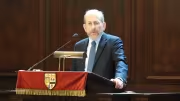
But influenza is an issue of national security, Harvard School of Public Health (HSPH) dean Julio Frenk said today in a talk sponsored by the HSPH Center for Public Health Preparedness: “Improved health can contribute to the stability and prosperity of nations.”
Although governments worried about a possible pandemic may be inclined to turn inward, focusing on keeping H1N1 flu out of their countries through immigration control and quarantines, that attitude is futile, Frenk said: “We live in an international world, and the global and the domestic are now one and the same.”
In fact, he said, a pandemic “highlights the need for global cooperation.” The governments of wealthier countries, although concerned about having enough flu medication to treat their own citizens, have still managed to cooperate in creating a global stockpile of medicine in case of a large outbreak in a country not equipped to manufacture or purchase the necessary drugs. Frenk voiced hopes that countries would exhibit similar magnanimity when a vaccine becomes widely available (expected to happen next month): An “every country for itself” approach, he said, “would truly be a disaster.”
Although we typically draw a clear line between terrorism and communicable disease, that line blurs when considering biological agents. Furthermore, Frenk said, there are cases of “involuntary biological warfare,” in which the spread of disease has the effect of subjugating a population, as happened when Europeans brought smallpox to the Americas.
Security, as defined in the wake of the September 11 attacks, can be a foundation for a more broadly defined global health security that envelopes not only disease outbreaks, but also healthcare security—access to healthcare—and financial security: “protection against the economic consequences of disease…protection against the risk of going broke from getting sick.” (Hence the talk’s title, “The H1N1 Pandemic and Global Health Security.”)
During financial downturns, Frenk explained, there’s a danger of backsliding as nations and individuals find it harder to cover the costs of healthcare. But governments got lucky in the sense that the first wave of H1N1 caused few deaths and was quelled with relative ease. Because they have had plenty of time to get their ducks in a row for the second wave, Frenk said, the public won’t have much patience “for justifying failures in this next response.”
He deemed the response to the first wave “quite competent, though far from perfect.” Taking Mexico, where the first wave began earlier this year, as a case study, Frenk said “hundreds of lives were saved” through the government’s brave choice to report the outbreak publicly, even though it knew that would bring tourism to a halt.
Mexico had also done well to put in place a well-functioning disease surveillance system, he said. (In a flourish of school pride, he noted the presence of several HSPH graduates in the country’s health ministry; he did not mention that he himself headed the ministry from 2000 to 2006.)
Frenk joked that perhaps the ministry’s most laudable achievement was convincing people to forgo physical contact during greetings, “something very hard to do with people of Latin heritage.”