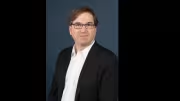
Freed professor of government Daniel Carpenter’s Reputation and Power, which will be featured in the "Off the Shelf" column in the September-October issue, is mentioned in James Surowiecki’s article “The Regulation Crisis” in June 14’s New Yorker. Carpenter’s book is a history of the Food and Drug Administration (FDA), “one of the few [regulation] agencies that’s been consistently effective,” according to Surowiecki. Highlighting Carpenter's argument that the FDA’s success is in large part due to “its staffers’ dedication to protecting and enhancing its reputation for competence and vigilance,” Surowiecki says that regulators must have a sense of both independence and purpose if they are to be effective.
The New York Times ran a profile of Harvard Medical School professor of genetics George Church on June 8. Church, whose research was featured in "DNA as Data" (January-February 2004), is a self-described “‘polyglot who believes in integration,’” and has an extraordinary range of scientific interests and projects. At his lab at the Medical School he oversees the work of 45 students; he is also involved in 22 businesses, whose work focuses on areas such as synthetic biology, genetic sequencing, and biofuels.
The article explores the Personal Genome Project, Church's ambitious mission to sequence the entire genomes of 100,000 people. (He already has captured some famous ones, including that of Johnstone family professor of psychology Steven Pinker.) “‘The goal of getting your genome done is not to tell you what you will die from,’” Church says in the Times article. Rather, he says it is “‘to learn how to take action to prevent disease.’” Church, who arrived at Harvard in 1977 and astounded his colleagues with his visionary integration of disciplines, has no intention of slowing down. “‘I like to keep the median age in my lab low because they will indulge me in my dreams…They don’t yet think things are impossible.’”