McKay professor of the practice of biomedical engineering David Edwards, envisioning the future of artistic-scientific creativity, advocates the establishment of labs that would be combinations of science centers and art galleries, where technological innovation and aesthetic expression would be brought into fruitful collaboration. "I argue for a lab that improves the dialog between creators and the public around the creative process while erasing conventional boundaries between art and science," Edwards declares in the first chapter of his new book The Lab: Creativity and Culture, due out in October from Harvard University Press.
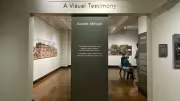
He has already founded two of these labs—Le Laboratoire, in Paris, and The Laboratory at Harvard. (Read Harvard Magazine's 2009 article on the Laboratory.) The idea is based on the early twentieth-century German art school known as the Bauhaus, where multiple arts and crafts were studied alongside each other. What these centers will facilitate, Edwards argues, is "idea translation"—the process by which early, possibly vague concepts are brought, by experimentation and collaboration, to tangible outcomes.
In an undergraduate course, Edwards leads students through this very process; read this magazine's account of the course's first year, in which students tackled everything from engineering nanofood particles to combat childhood obesity, to designing keyboards that prevent repetitive-stress injuries. But he wants to go beyond the university. He believes it is imperative for societies to adopt a more creative, less rigid approach to problem solving: "In an age when society and culture are rapidly evolving, large institutions need to adapt if they are to respond positively to the needs and opportunities of a changing world."