William James centennial conference and exhibition

A conference and an exhibition at Houghton Library showcase the legacy of the pioneering psychologist and philosopher.

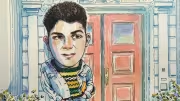
An 1866 self-portrait, when James was about 24 years old

An 1866 self-portrait, when James was about 24 years old | Courtesy of the Houghton Library, Harvard College Library/Gift of the James Family/MS Am 1092.2 (54)

William James reading, 1895

William James reading, 1895 | Courtesy of the Houghton Library, Harvard College Library/Gift of the James Family/pf MS Am 1092 (1185) #71

Here I and Sorrow Sit, an 1860s, red-crayon drawing echoing James’s depression

Here I and Sorrow Sit, an 1860s, red-crayon drawing echoing James’s depression | Courtesy of the Houghton Library, Harvard College Library/Gift of the James Family/MA Am 1092.2 (55)

James wearing sunglasses in Brazil, 1865, after suffering a mild form of smallpox on an expedition with Louis Agassiz

James wearing sunglasses in Brazil, 1865, after suffering a mild form of smallpox on an expedition with Louis Agassiz | Courtesy of the Houghton Library, Harvard College Library/Gift of the James Family/pf MS Am 1092 (1185) #9

A century after his death in August 1910, William James, M.D. 1869, LL.D. 1903, remains an outstanding figure in both philosophy and psychology. He is as illustrious a scholar as Harvard has ever produced, and one of the very few to shine brightly in two disciplines.

In mid August, the William James Society (www.wjsociety.org) convened an unusual conference, “In the Footsteps of William James,” for the centennial. For its first three days, about 80 Jamesians gathered in Chocorua, New Hampshire (where their cynosure maintained a summer residence from 1886 onward), to sample dozens of scholarly presentations, tour James’s house and barn thanks to the cooperation of its current owners, and enjoy the trails and lake. For the final day, the group decamped to Cambridge, taking in an exhibition of Jamesiana, “Life is in the Transitions,” at Houghton Library (https://tinyurl.com/wjames), which runs until December 23.

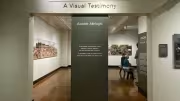
The transitions include James’s personal crisis of March and April 1870, an episode of what he called “soul-sickness.” The Houghton exhibit explores several of his life passages using letters, sketches, photographs, diary entries, and lecture notes, as well as a few personal objects like the large envelope he inscribed, “My unfinished book,” which held a working manuscript. There is a touching 1876 love letter to his future wife, Alice Howe Gibbens, that declares, “To state abruptly the whole matter: I am in love, und zwar [namely] (--forgive me--) with Yourself.” There’s also correspondence with his novelist brother Henry James, Litt.D. 1911, whose large, florid script contrasts sharply with William’s neat handwriting. The exhibit fleshes out how James was first hired to teach at Harvard, his academic home for virtually his entire career. It also explores his forays into psychical research, séances, and, of course, several varieties of religious experience. Lastly, it records James’s final transition--with a death mask and a photograph of the beloved professor in repose after passing away at his summer home on August 26, 1910.
You might also like

There’s a New Sargent Painting in Town

Harvard Art Museums restores a rare glimpse of an American master.

Don’t Call Stephanie Pierce A Paleontologist

From competing in youth gymnastics to studying tetrapods, the Harvard curator has always chased her curiosity.

At Harvard’s Peabody Museum, Photos Reimagine Iranian History

Artist Azadeh Akhlaghi reconstructs moments of Iranian political upheaval in a series of meticulously staged images.

Most popular

Keri Russell Calls ‘The Diplomat’ a Love Letter to Public Servants

A Harvard Kennedy School event looks behind the scenes of the Netflix drama. 

The Year a Beat Poet Squatted at Harvard

In 1954, Gregory Corso moved into Eliot House. How he stayed there is a literary legend.

How Philosophy at Harvard Saved Itself

As humanities shrink across higher education, one department is flourishing. Is its success a fluke, or a roadmap?

Explore More From Current Issue

Bronze statue of a seated figure holding a book, with a campus setting in the background.

As humanities shrink across higher education, one department is flourishing. Is its success a fluke, or a roadmap?

Collage of three photos of an athlete in a triathlon: one swimming, one cycling, one running, in sports attire.

The Harvard triathlete and coach says she helps normal people to “do extraordinary things.”

Delicate green cocoa pods and small white flowers on a tree branch, surrounded by soft greenery.

Harvard researchers investigate climate’s impact on cocoa crops, innovations in nasal vaccines, and links between pain and skull marrow.