The Isabella Freedman Jewish Retreat Center in Falls Village, Connecticut

Organic farming and spiritual retreats in a camp-like atmosphere

The Isabella Freedman Jewish Retreat Center

The Isabella Freedman Jewish Retreat Center | Photograph courtesy of the Isabella Freedman Jewish Retreat Center

The Isabella Freedman Jewish Retreat Center

The Isabella Freedman Jewish Retreat Center | Photograph courtesy of the Isabella Freedman Jewish Retreat Center

The Isabella Freedman Jewish Retreat Center

The Isabella Freedman Jewish Retreat Center | Photograph courtesy of the Isabella Freedman Jewish Retreat Center

The Isabella Freedman Jewish Retreat Center

The Isabella Freedman Jewish Retreat Center | Photograph courtesy of the Isabella Freedman Jewish Retreat Center

The Isabella Freedman Jewish Retreat Center

The Isabella Freedman Jewish Retreat Center | Photograph courtesy of the Isabella Freedman Jewish Retreat Center

The Isabella Freedman Jewish Retreat Center

The Isabella Freedman Jewish Retreat Center | Photograph courtesy of the Isabella Freedman Jewish Retreat Center

The Isabella Freedman Jewish Retreat Center

The Isabella Freedman Jewish Retreat Center | Photograph courtesy of the Isabella Freedman Jewish Retreat Center

The Isabella Freedman Jewish Retreat Center

The Isabella Freedman Jewish Retreat Center | Photograph courtesy of the Isabella Freedman Jewish Retreat Center

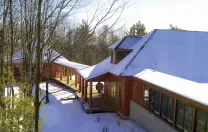
The Isabella Freedman Jewish Retreat Center in Falls Village, Connecticut, offers year-round programs, is home to a six-acre organic farm, and promotes “community and pluralism and ecological consciousness,” according to program manager Adam “Segulah” Sher.

A popular annual meditative retreat, “The Gift of Silence,” runs from Christmas Day to New Year’s Day, and another one is planned for the summer. Other kinds of group religious retreats, as well as educational classes and workshops, are offered throughout the year. There is a glass-walled synagogue overlooking a lake and the Berkshire foothills. Shabbat and prayer services are offered at specific retreats. The kitchen and dining room are glatt kosher, but the retreat is flexible about Shabbat and other religious practices. “If you want to use your cell phone on a Saturday,” Sher notes, “nobody will question that.”

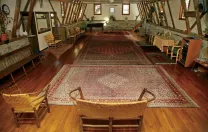
There is also plenty of opportunity to rest and relax in this camp-like environment. Most of the visitors live in cities and enjoy coming to learn about organic farming practices—the center grows its own vegetables, raises animals, and produces dairy products—and experience the natural beauty. The campus has numerous walking and hiking trails, and people swim and boat on the lake. “It’s so dark at night you can see the stars,” Sher says. “We build a fire in winter and people sit quietly. People feel they can create their own retreat experience.”
Most popular

The University has pushed the adoption of AI into teaching and operations, but faculty resistance is growing louder.

Harvard’s Class of 2029 Reflects Shifts in Racial Makeup After Affirmative Action Ends

International students continue to enroll amid political uncertainty; mandatory SATs lead to a drop in applications.

Citing improper procedure, a district judge postponed the government’s efforts to cap student visas at four years.

Explore More From Current Issue

A busy classroom filled with students working at computers, colorful decor, and a bright atmosphere.

In 2004, a frenzy spread across Harvard Yard in days. Four billion users later, we are only just catching up.

Two laboratory researchers, one seated and one standing, in a scientific lab with equipment.

The stakes are high for this husband and wife: one of them will die if they don’t find a cure.

Caricature of a young man in front of red doors, wearing a green striped sweater.

In 1954, Gregory Corso moved into Eliot House. How he stayed there is a literary legend.