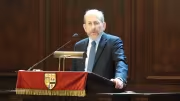
The first African-American Attorney General of the United States, Eric H. Holder Jr., will be the 2012 Class Day speaker for Harvard Law School’s commencement ceremony on Wednesday, May 23, the school has announced.
Holder was named to the Cabinet post in 2008 after serving as senior legal adviser to President Barack Obama, J.D. ’91, and later as one of three members on the vice-presidential selection committee. "He has distinguished himself as a prosecutor, a judge, and a senior official, and he is deeply familiar with the law enforcement challenges we face—from terrorism to counterintelligence; from white-collar crime to public corruption," Obama said at the time, as reported on the PBS Newshour. Prior to his appointment, Holder worked for the U.S. Department of Justice, prosecuting corruption cases involving public officials; earlier he served as an associate judge with the Superior Court of the District of Columbia, a deputy U.S. attorney general, and a litigation partner in the Washington D.C. firm Covington & Burling.
According to The New York Times, Holder has a history of being sponsored for prominent positions by presidents of both parties—he was named a U.S. attorney and then deputy attorney general by President Clinton in 1997, and served for five years as an associate judge on the Superior Court of the District of Columbia , following his nomination by President Reagan in 1988.
Recently, Holder has become one of the most controversial members of the Obama administration, particularly for his efforts to use the criminal justice system to handle certain terrorism cases, and for a speech delivered at Northwestern University’s law school on March 5, in which he called it lawful for the government to kill American citizens if officials deem them to be operational leaders of Al Qaeda and if capturing them alive is not feasible. “Given the nature of how terrorists act and where they tend to hide, it may not always be feasible to capture a United States citizen terrorist who presents an imminent threat of violent attack,” Holder said in the speech, according to the Times. “In that case, our government has the clear authority to defend the United States with lethal force.”
He has also come under fire for the "Fast and Furious" scheme, a failed attempt by the Bureau of Alcohol, Tobacco, Firearms, and Explosives to seed and then track U.S. firearms to Mexican drug cartels, which has been linked to the 2010 killing of a Border Patrol agent. According to The Huffington Post, Holder told Congress he had not authorized the operation's controversial "gun-walking" tactics, which allowed illegal guns to fall into the hands of Mexican drug traffickers, calling those tactics "unacceptable" and "stupid."
Born in 1951 in the Bronx and raised in Queens, Holder attended Stuyvesant High School, where he earned a Regents Scholarship. He graduated from Columbia University and then Columbia Law School, during which time he clerked at the NAACP Legal Defense Fund and the Justice Department’s criminal division. He later moved to Washington and joined the department as part of the Attorney General’s Honors Program; he was assigned to the newly formed Public Integrity Section in 1976, tasked to investigate and prosecute official corruption on the local, state, and federal levels.
This past December Holder vowed to fully enforce civil rights protections in the face of new state laws that some feel will decrease minority voting in the upcoming elections: “We need election systems that are free from fraud, discrimination, and partisan influence—and that are more, not less, accessible to the citizens of this country,” he said according to the Times.