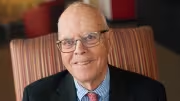
Martin Karplus '51, Richards professor of chemistry emeritus, today was awarded the Nobel Prize in chemistry, along with Michael Levitt, of the Stanford University School of Medicine, and Arieh Warshel of the University of Southern California. They were recognized “for the development of multiscale models for complex chemical systems.” According to the Nobel press release:
Chemists used to create models of molecules using plastic balls and sticks. Today, the modelling is carried out in computers. In the 1970s, Martin Karplus, Michael Levitt and Arieh Warshel laid the foundation for the powerful programs that are used to understand and predict chemical processes. Computer models mirroring real life have become crucial for most advances made in chemistry today.
Chemical reactions occur at lightning speed. In a fraction of a millisecond, electrons jump from one atomic nucleus to the other. Classical chemistry has a hard time keeping up; it is virtually impossible to experimentally map every little step in a chemical process. Aided by the methods now awarded with the Nobel Prize in Chemistry, scientists let computers unveil chemical processes, such as a catalyst’s purification of exhaust fumes or the photosynthesis in green leaves.
Karplus's website describes his research as
directed toward understanding the electronic structure, geometry, and dynamics of molecules of chemical and biological interest. In each study a problem that needs to be solved is isolated and the methods required are developed and applied. In recent years, techniques of ab initio and semi-empirical quantum mechanics, theoretical and computational statistical mechanics, classical and quantum dynamics as well as other approaches, including experimental NMR, have been used.