The Mark I, the first programmable computer in the United States, hummed briefly back to life yesterday, 70 years after performing its first calculations. Gears whirred and parts moved back and forth, drawing cheers from the assembled crowd even though no computations were made. Likewise in attentive attendance were dozens of the machine’s electronic descendants: smartphones, cameras, and at least one wearable computer, Google Glass, all bore witness to how far computer science has come.
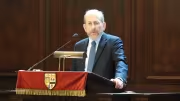
The brief reboot of the Mark I celebrated the opening of a newly redesigned exhibit centered on the machine. The computational monster was 55 feet long, eight feet tall, and weighed five tons in total, though only part of the machine remains on display in the Science Center lobby. In the 1930s, explained Cherry Murray, dean of the School of Engineering and Applied Sciences, a Harvard graduate student in physics, Howard Aiken, dreamed up the machine as a way to speed up tedious calculations. The Automatic Sequence Controlled Calculator, as the Mark I was originally known, was built by IBM and presented to Harvard in August 1944. For 15 years, it played an important role in U.S. military efforts, solving differential equations called Bessel functions (for which it earned the nickname "Bessie") and running a series of calculations that helped design the atomic bomb.
By its 1959 retirement, the Mark I had carved out a place in computing history—as well as popular culture. “One of the things that I love about this machine is that it embodies, in a very direct, literal way, terms that we’re used to—like the ‘bug’, the ‘loop,’ and the ‘library,’” said Pellegrino University Professor Peter Galison, who directs the Collection of Historical Scientific Instruments. On one occasion, for instance, the Mark II, a descendent of the Mark I, was famously laid low by a moth that became trapped in its inner workings. Programmer Grace Hopper attached it to the operations logbook with the comment, “First actual case of bug being found.”
In the Mark I’s time, few researchers imagined that computers would ever be widely used, remarked Michael D. Smith, dean of the Faculty of Arts and Sciences and himself a computer scientist. Allegedly, IBM chairman Thomas Watson predicted, “I think there is a world market for maybe five computers.” Now, said Smith, “If you grab the undergraduate sitting next to you and empty their pockets and look in their backpack, you’re going to find five computers just hanging out there.”
“We’ve come a long way in the last 70 years in thinking about what these machines can do,” he concluded. “I hope we’ve learned how to apply those lessons for the next 70 years.” With that, a loud, deep hum filled the air as the Mark I churned back to life, signaling its agreement.
For more on computational science then and now, see “A Toolkit in 0s and 1s.”