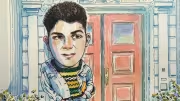
Filmmaker Robert Gardner Dies at 88

The anthropological filmmaker founded the Harvard Film Study Center.

Robert Gardner in his Cambridge home, October 2013

Robert Gardner in his Cambridge home, October 2013 | Photograph by Rose Lincoln/Harvard Public Affairs and Communications

Robert Gardner ’48, A.M. ’58, the noted anthropological filmmaker who founded the Harvard Film Study Center, has died of cardiac arrest at age 88, as The New York Times and The Boston Globe have reported. Gardner taught filmmaking in the department of visual and environmental studies for many years. He directed the Film Study Center from 1957 until 1997 and for decades remained a leader of the University’s filmmaking community. His wife, psychiatrist Adele Pressman ’68, announced Gardner’s death.

The Film Study Center grew out of early work that Gardner and others did at the intersection of anthropology and filmmaking in the 1950s. Among his landmark films are Dead Birds (1964), on the Dani people of New Guinea, who traditionally engage in ritual warfare and whom Gardner filmed during a 1961 expedition there, and Rivers of Sand (1974), which beautifully documents the society of the Hamer tribe of Ethiopia. Forest of Bliss (1986) explores life in the holy city of Benares, India, eschewing both narration and dialogue. Viewers cherished Gardner’s films for their anthropological interest, the beauty of their cinematography, and their storytelling skill. Harvard Magazine described Gardner’s anthropological filmmaking ventures in several stories, including a Harvard Portrait (1974), “Rivers of Sand” (1974), and “City of Light” (1986). 
You might also like

The division is launching a new fundraising effort to support 50 additional students.

President Alan M. Garber used traditional Memorial Church address to consider the unique qualities of human intelligence and learning.

Due to rain, the University held dual Convocation ceremonies for the Class of 2030 in Sanders Theatre.

Most popular

Harvard’s Class of 2029 Reflects Shifts in Racial Makeup After Affirmative Action Ends

International students continue to enroll amid political uncertainty; mandatory SATs lead to a drop in applications.

The University has pushed the adoption of AI into teaching and operations, but faculty resistance is growing louder.

In 1954, Gregory Corso moved into Eliot House. How he stayed there is a literary legend.

Explore More From Current Issue

A vase of yellow flowers on a table next to an orange and a glass.

Harvard Art Museums restores a rare glimpse of an American master.

Modern building with large glass windows, surrounded by greenery and pedestrians.

A roundup of University news from the summer of 2026

A vibrant illustration of a red car parked, surrounded by cheerful people and historic buildings.

Derek Bok donated his car for a good cause.