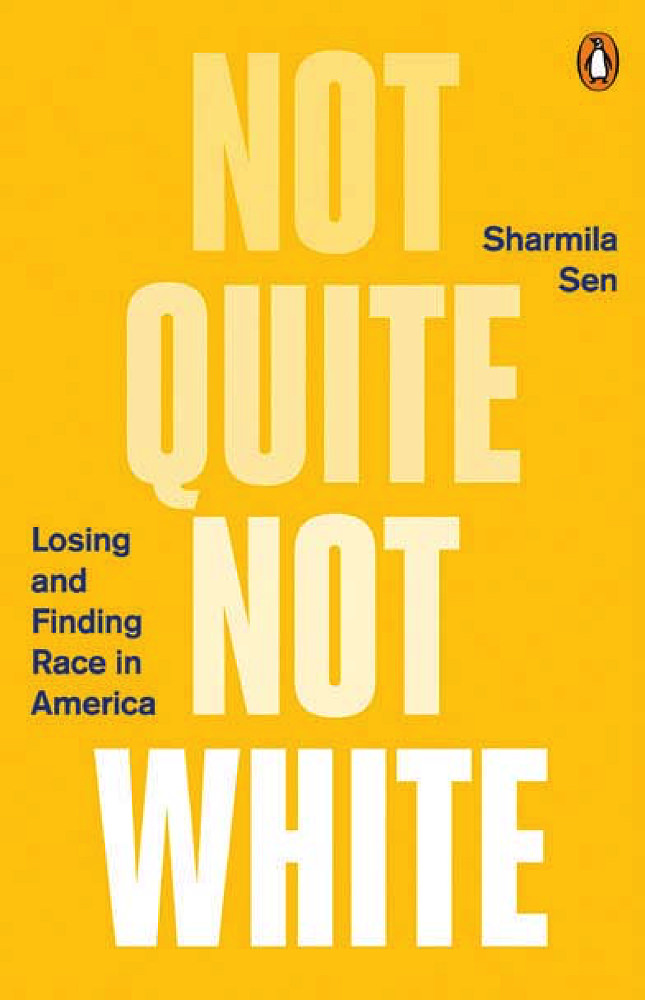
In 1982, Sharmila Sen’s family arrived in Cambridge from Calcutta with six bags and $60, dressed in their best clothes. In India, they were upper-caste Hindu Bengalis, Anglophone-educated and downwardly mobile, their privilege precarious. They would soon learn that the United States had its own hierarchy. Not Quite Not White: Losing and Finding Race in America (Penguin Books, $16) retraces that journey, its comic scenes from girlhood—studying Hawaii Five-O, whipping up no-bake Jell-O desserts every day—cut with wry observation.
America gave Sen ’92 new manners (“The Proper Use of Salt and Pepper”; “The Blessed Sneeze”; “The Indoor Voice”); more deeply, over time, she also “got race”: “I got race the way people get chicken pox. I also got race as one gets a pair of shoes or a cell phone. It was something new, something to be tried on for size, something to be used to communicate with others. In another register, I finally got race, in the idiomatic American sense of fully comprehending something. You get what I’m saying? Yeah, I get you.”
In this passage, Sen, now executive editor-at-large at Harvard University Press, recalls the flush of humiliation she felt as a 12-year-old when people asked why her family had immigrated:
We weren’t chic expats or political dissidents with lofty ideologies. We were three people moving from a country with fewer resources to one with greater resources. I doubt we added glamour or value to our surroundings.
“Why did your parents come to America?”
“For better jobs.”
To this day this small exchange—repeated endlessly throughout my years in the United States—instantly determines the social hierarchy between my interlocutor and me. I wish I could say my parents possessed some extraordinary professional skill for which an American institution wooed them. We did not hold noble political or religious convictions that were at odds with the government of India. There was no war raging in my city and we were not being resettled. Homo economicus has a duller, more prosaic story to tell.
“Why did your parents come to America?”
“For better jobs.”
The native-borns nod and feel pleased that they are citizens of a country that offers better everything—jobs, homes, food, schools, music. I would feel the same if I was in their shoes. It must feel good to be born in a country that has more wealth than other places, to have the hardest currency in your wallet. It must feel good to be generous and invite others—after intense vetting and preselection—to share in this plenty. Even though I had no say at all in my family’s decision to emigrate, I felt my shoulders weighed down with the plenitude of the host country. This plenitude of which I was to be the grateful recipient was evidence that white people were superior to people like me. How else could one nation be so wealthy and another be so poor; one country have so much to give and another stand in a queue to receive? The inequality of nations was surely a sign that some races were morally, physically, and intellectually superior to others. The inequality of nations surely had nothing to do with man, but was shaped by Providence.
“Why did your parents come to America?”
“For better jobs.”