Headquarters

Artemas Ward, A.B. 1748, A.M. '51, lay ill in bed on April 19, 1775, as embattled farmers fired the shot heard round the world. But when a...

Artemas Ward, A.B. 1748, A.M. '51, lay ill in bed on April 19, 1775, as embattled farmers fired the shot heard round the world. But when a courier reached the Ward homestead in Shrewsbury, Massachusetts, to say the fighting had begun, Ward arose and rode to Cambridge, where, with only the authority given him by a provincial congress, he took charge of ragtag forces and led an armed rebellion against a superpower as the first commander in chief of the American Revolution. General George Washington, elected by the Continental Congress to lead the combined troops of the colonies, took over from General Ward on July 2, 1775.

Active in both colonial and state government, Ward was a chief justice of the Court of Common Pleas and speaker of the state house of representatives. He also served in the U.S. Congress, aligned with the Federalists. In late 1797, he "quit the theatre of action," as he wrote his daughter, and after two years of quiet retirement in Shrewsbury, he died in October 1800 at age 73.
Photographs by Jim Harrison

The homestead remained in the family until 1926, when another Artemas, A.B. 1899, gave it to Harvard. From April to November, it is open, free of charge, as a tourist attraction (for hours, call 508-842-8900). Phillips professor of early American history Laurel Thatcher Ulrich thinks that, along with the Ward papers in various depositories, the place in future could be "a truly exemplary site for the study of American culture," and she isn't alone in hoping that it will be.

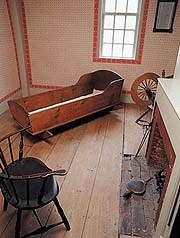
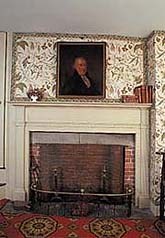
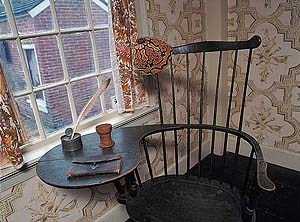
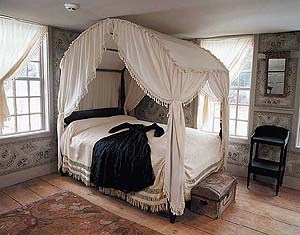
Many of the furnishings of the home are not of the general's era. But he could have slept in the Chippendale canopy bed shown above. There he is over the mantel, in a portrait attributed to Raphael Peale. Ward's yellow, one-horse shay, now very rare, is in the barn (a huge structure built in 1848 and a model of progressive agriculture). The adult-sized cradle at left was used by his invalid sister Martha, but elsewhere; Artemas and his brother Elisha were charged with her care in their father's will, but they farmed her out. The Windsor writing chair above might well have accommodated the general, "rather overstern in demeanor; somewhat slow in speech and with a biblical turn to his conversation; inflexible in his ideas," writes his biographer, Charles Martyn, "and fully convinced that the Massachusetts Bay Colony was the land most approved by Providence, and that those of Massachusetts were the Chosen People."        

Most popular

Why Men Are Falling Behind in Education, Employment, and Health

Can new approaches to education address a growing gender gap?

The 1884 Cannibalism-at-Sea Case That Still Has Harvard Talking

The Queen v. Dudley and Stephens changed the course of legal history. Here’s why it’s been fodder for countless classroom debates.

Trump Administration Appeals Order Restoring $2.7 Billion in Funding to Harvard

The appeal, which had been expected, came two days before the deadline to file.

Explore More From Current Issue

A jubilant graduate shouts into a megaphone, surrounded by a cheering crowd.

For Campus Speech, Civility is a Cultural Practice

A former Harvard College dean reviews Princeton President Christopher Eisgruber’s book Terms of Respect.

A man skiing intensely in the snow, with two spectators in the background.

Introductions: Dan Cnossen

A conversation with the former Navy SEAL and gold-medal-winning Paralympic skier

A bald man in a black shirt with two book covers beside him, one titled "The Magicians" and the other "The Bright Sword."

Novelist Lev Grossman on Why Fantasy Isn’t About Escapism

The Magicians author discusses his influences, from Harvard to King Arthur to Tolkien.