![John Parker and Edward Wakeline, Silver Teapot. [ca. 1765]](/sites/default/files/styles/mobile_16_9_small/public/img/article/0211/h4_sm.jpg.avif?itok=8n1uN01z "Houghton Library/Harvard College Library/© President and Fellows of Harvard College")


Imagine you are curator-in-chief of all of Harvard’s collections of tangible things and a donor gives you a 114-year-old Mexican tortilla. Where in your almost 50 collections do you put it?
Tangible Things, an exhibition on view through May 29, principally at galleries of the Historical Scientific Instruments Collection in the Science Center, brings together roughly 200 intriguing things--art works, specimens, tools--from troves throughout the University. Around the periphery of the galleries, write the exhibition organizers, “are objects displayed according to categories used at Harvard and elsewhere since the nineteenth century, categories that were instrumental in creating the disciplinary boundaries that still define many of our undergraduate concentrations and that still structure many of the world’s museums.” In the middle of the space is an array of seemingly inscrutable objects. Viewers are challenged to decide in what collections to place them--and why. What about that tortilla?
To further their points about categories and meanings, exhibition organizers have taken things from their usual locations--including the three shown on this page--and placed them as “guest objects” in seven other museums at Harvard, inviting viewers to go on a scavenger hunt to find them. A palette used by painter John Singer Sargent (1856-1925) is normally housed at the Harvard Art Museums, with paintings by the master. In Tangible Things, it is at the Science Center, shown as a tool along with items related to color and the brain.
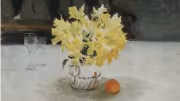
The floriform vase made by Louis Comfort Tiffany around 1900 is also usually at the Art Museums, but is for the moment a guest at the Harvard Museum of Natural History, where it sits among the celebrated glass flowers made by the Blaschkas, father and son. Visitors may wonder about the line drawn between art and science. Why were the Blaschkas’ flowers considered scientific tools, while Tiffany’s were art?
The walking plow, probably Massachusetts-made in the late eighteenth century, from Harvard’s General Artemas Ward House Museum in Shrewsbury, Massachusetts, is saved there because of its associations with the Revolutionary War general, A.B. 1748. It is now a guest at the Semitic Museum, near an Iron Age plow of similar design.
The exhibition is the work of 300th Anniversary University Professor Laurel Thatcher Ulrich; senior lecturer Ivan Gaskell; Wheatland curator of the Collection of Historical Scientific Instruments Sara Schechner; and lecturer Sarah Anne Carter. (Ulrich and Gaskell are teaching a new General Education course with the same title.) They found their tortilla in the Economic Botany Herbarium of Oakes Ames.