Nuclear waste from the Manhattan Project is linked to higher rates of cancer among people who grew up near Missouri’s Coldwater Creek between the 1940s and the 1960s, according to a new Harvard study that is among the very few to explore cancer risk and low-exposure environmental radiation.
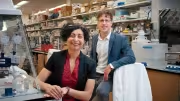
Drinker professor of environmental epidemiology and physiology Marc Weisskopf and postdoctoral research fellow Michael Leung led the research, which focused on the effects on residents living near the creek—a tributary of the Missouri River near St. Louis—rather than on nuclear-waste workers or bomb survivors who might have faced high-exposure radiation environments.
The study found that people living more than 20 kilometers (12 miles) away from the polluted creek, where nuclear waste had been illegally dumped in a nearby quarry and leaked into the waterway, had a 24 percent risk of developing any type of cancer. Residents less than one kilometer (0.6 miles) from the creek had a 44 percent risk of developing any type of cancer, and an 85 percent greater chance of developing breast cancer or another radiosensitive cancer.
This research is especially relevant given Congress’s recent passage of the Radiation Exposure Compensation Act (RECA), a part of the Trump tax bill, which enables Coldwater Creek residents to receive monetary compensation for medical bills resulting from their radiation exposure.
Weisskopf initially became interested in the associations between early-life environmental exposures and late-life health while investigating neurodegenerative-type conditions. “I got connected with someone who happened to have a collection of baby teeth that was donated by people back in the 50s and 60s,” said Weisskopf—as part of an earlier study of potential exposure effects linked to atmospheric nuclear testing.
So, the researchers began working with the collection of teeth: the St. Louis Baby Tooth—Later Life Health Study (SLBT) cohort. When Leung started analyzing the data for this study, explained Weisskopf, survey respondents began writing and calling them to say that they “ought to look at Coldwater Creek.”
Weisskopf and Leung consulted professor David Richardson, an expert in radiation epidemiology at the University of California, Irvine, who briefed them about potential radiation effects from Coldwater Creek. They began gathering data related to the contamination of the creek and then testing tooth samples to ascertain the feasibility of a study.
Narrowing the focus of their work to samples proximate to Coldwater Creek, Weisskopf and his team worked with 4,209 participants from the SLBT cohort, a group that had lived near Coldwater Creek as children, and later donated their baby teeth, beginning in 1958.
One of the largest hurdles they faced, Weisskopf recalled, involved geocoding: mapping the addresses of the tooth donors using data originally recorded on approximately 100,000 three-by-five-inch index cards.
While their study brought clarity about the effects of low-level radiation on residents near Coldwater Creek, the researchers are concerned about the long-term effects of radiation exposure in other regions of the country.
“There are other parts of Illinois close to the greater St. Louis area that are also affected, that most people haven’t even looked at,” said Leung. “So, this is really the tip of the iceberg.”
And Weisskopf expressed concern about the current rate of advancement of nuclear power. Even “at lower levels [of radiation], there may still be some important consequences. So, we’d better understand that more finely,” he said, to make sure “we’re being safe with however we’re handling either waste from those processes or the processes themselves.”
Weisskopf noted that these effects will be difficult for his lab to pursue further, given that the National Institutes of Health currently “won’t give any grant to Harvard.”
“It seems we would want to pursue these kinds of studies,” he said, “to understand the consequences of those exposures.”