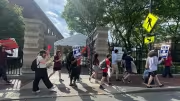
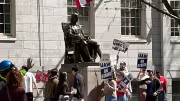
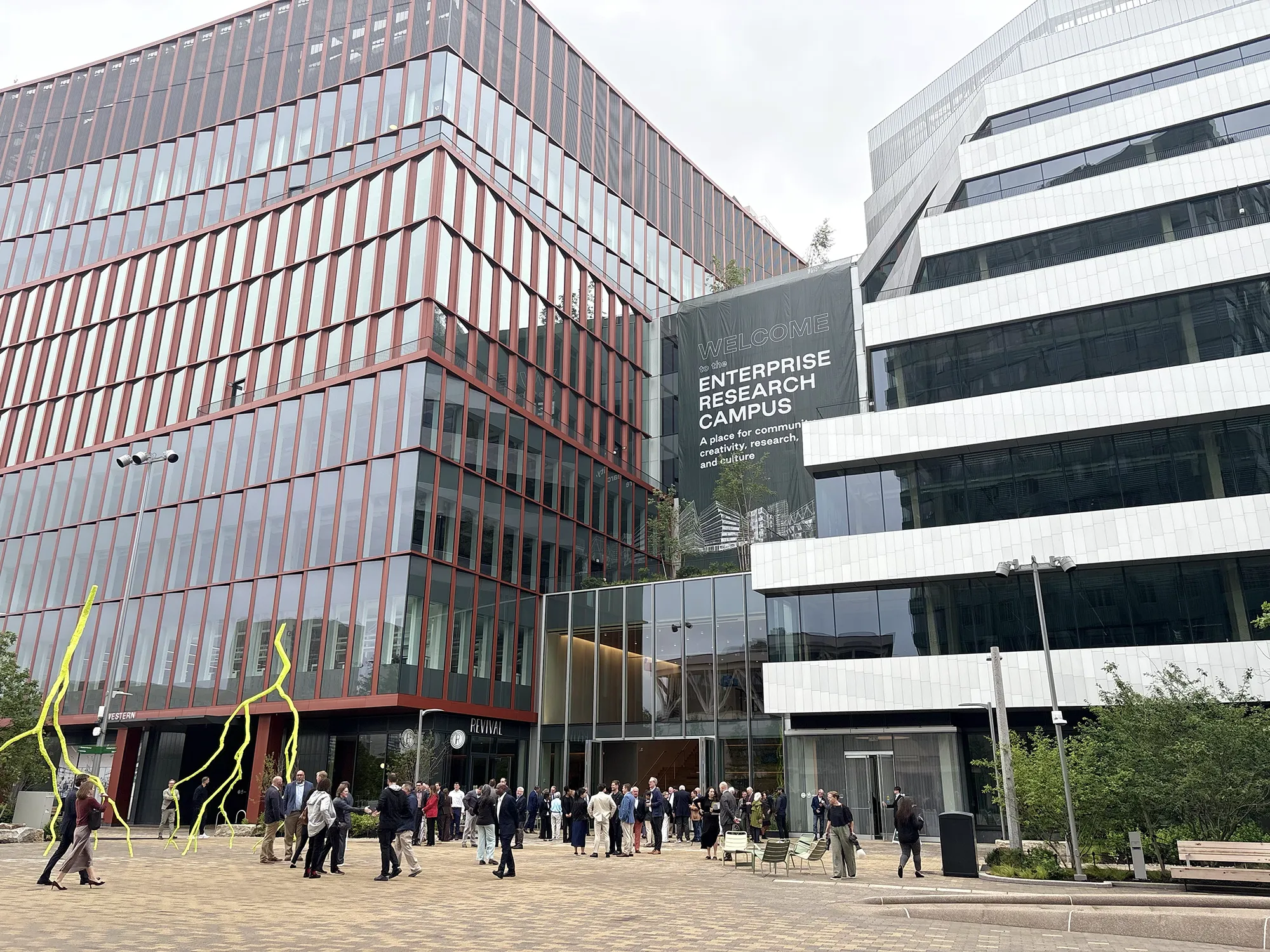
June 23 marked the official opening of the Enterprise Research Campus (ERC) in Allston, which debuted with a reception at One Milestone, the campus’s research building. A jazz quartet welcomed guests into a bright, glass-lined atrium as Harvard officials, community leaders, and Allston residents gathered to celebrate the debut of the long-awaited development.
Retail stores, a hotel, commercial lab space, and an apartment building have opened gradually across the nine-acre campus since January. But on Tuesday, University and Boston officials came together to celebrate the full completion of Phase A of the ERC—the latest milestone in Harvard’s expansion into Allston.
Now complete are two commercial research buildings, a residential apartment complex, the Atlas Hotel, Harvard’s Rubenstein Treehouse conference center, a collection of retail and restaurant tenants, and a two-acre greenway that will serve as the development’s public gathering space.
Guests looked out onto the landscaped greenway on Tuesday as they listened to a slate of speakers including Boston Mayor Michelle Wu ’07 and President Alan M. Garber, who lauded the years of planning, negotiation, and collaboration between Harvard and Allston that helped bring the ERC to life.
“For most of the last century, this area wasn’t home to scientists or students or families, it was occupied by big trucks and decaying train cars,” said Wu, “and so this chapter really kicks off a new home for everyone, and an opportunity that could not have been possible without neighbors, elected officials, labor leaders, Harvard, and [ERC developer] Tishman Speyer coming together to reach an agreement worthy of the aspirations of our city.”
State Representative Michael J. Moran, who has represented Allston since 2005, remarked that his earliest conversations with Harvard about plans for the ERC happened when Wu was still an undergraduate in 2007—and struck a very different tone than the morning’s celebrations.
“Harvard may be the biggest and oldest institution, but this community was here before it,” Moran said. “When I first took office in ’05, the relationships were not very strong and were not very good. As a matter of fact, you wouldn’t catch me dead at a Harvard ribbon cutting back in those years.”
But the completion of Phase A, he said, was a significant step forward in Harvard’s relationship with Allston, proving that the University and neighbors could collaborate on a large-scale project.
“We’ve come a long way with our relationship—the community, the electeds, and Harvard. It’s in a much better space, and let’s just keep that going for future years,” he added, “so we can have more ribbon cuttings like this.”
Rob Speyer ’91, the CEO of Tishman Speyer, credited much of the campus’s “neighborhood feel” to the Harvard Allston Task Force, a volunteer group of residents who advise the University about developments on Harvard-owned land in Allston.
“You made sure that this place really reflects Allston, and I hope you feel as good as I do about that,” Speyer said.
The feeling is, in part, achieved by intentionally bringing in small local business. With Boston and Cambridge-based restaurants, coffee shops, and a new Harvard COOP storefront, Harvard Allston Land Company CEO Jennifer Cohen said it “doesn’t get much more local than that.” Local restaurants—including Ama at the Atlas, the first restaurant to open on the ERC—catered the opening ceremony.
Increased affordable housing in Allston was a central point of negotiation in the years-long approval process for the ERC. Tishman Speyer and Harvard agreed to designate 25 percent of the residential units in this first phase as income-restricted and Harvard pledged another $25 million to establish a new affordable housing fund dedicated to Allston and Brighton. Verra, a 343-unit residential development with 86 income-restricted affordable units, opened in January. The next phase of development is expected to include another 320,000 square feet of housing.
Boston City Council President Liz A. Breadon, who represents Allston-Brighton, praised the project as a model for balancing development with neighborhood priorities, pointing to the housing commitments and community benefits.
“We are very grateful to Harvard and to Tishman Speyer for raising the bar [so] that this project can deliver housing, wonderful open space, and connectivity to the neighborhood, jobs, public life, and lasting neighborhood benefits,” Breadon said.
The remainder of the ERC’s initial 14-acre buildout will be completed in a second stage currently under regulatory review by the Boston Planning and Development Agency.
But full completion of Harvard’s 36-acre vision for the ERC remains contingent on the Allston Multimodal Project, which will reorient the Massachusetts Turnpike and its off-ramps and reorganize surrounding rail infrastructure, opening up an additional 100-acres of Harvard-owned land that is currently cut off from the rest of the neighborhood by an elevated highway and rail yard. The state turnpike project was stalled after losing significant federal funding with Congress’s signing of the “One Big Beautiful Bill Act” in July 2025.
“A bit of the division and the harm and the separation that was caused by the interstate running through is now slowly starting to be knitted back together through generations of vision and persistence and community advocacy,” Wu said. “We’re standing next to the most remaining land for development in Boston, more than 100 acres, and this campus shows what the rest of it can be too.”