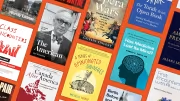
Forgive Us Our Debts: The Intergenerational Dangers of Fiscal Irresponsibility, by Andrew L. Yarrow, M.P.A. ’94 (Yale, $25). “[D]espite centuries of distaste for debt,” the United States government will owe $10 trillion by election day—and has promised another $50 trillion or so of benefits. The unchecked debt spree threatens “night time in America,” the author suggests, and “morning in China.”
The (Un)happy Lawyer, by Monica Parker ’92, J.D. ’99 (Sourcebooks, $14.95, paper). An erstwhile lawyer herself, Parker now plies her trade as a coach for those exiting the profession. Here is her written “roadmap to finding meaningful work outside of the law” (presumably while still complying with it).
The Freedom Agenda: Why America Must Spread Democracy (Just Not the Way George Bush Did), by James Traub ’76 (Farrar, Straus and Giroux, $25). One reporter’s take on promoting democracy and why it would be good for the nation to “get caught…behaving in conformity with our deepest principles.”

Photograph by Clifford Boehmer / Harvard University Press
Making a living in the narrow alleyways and streets of Wan Chai, in Hong Kong.
City between Worlds: My Hong Kong, by Leo Ou-fan Lee, professor of Chinese literature emeritus (Harvard University Press, $29.95). An attractively illustrated history, cultural guide, and sidewalk tour of the author’s home city, where he now teaches at the Chinese University.
High Performance with High Integrity, by Ben W. Heineman Jr. ’65 (Harvard Business Press, $18). A brief, brisk book of guidelines for profitable, principled business operations, by GE’s senior vice president-general counsel from 1987 to 2003. There, he writes, “We weren’t going to repeal human nature, but we sought to reduce improprieties to a minimum.”
The Legacy of the Mastodon, by Keith Thomson ’61, Ph.D. ’63 (Yale, $35). The former director of the Oxford University Museum of Natural History traces “the golden age of fossils in America” from Thomas Jefferson (fascinated by mastodon fossils) forward—150 years of pioneering and frontier paleontology.
The Candy Bombers: The Untold Story of the Berlin Airlift and America’s Finest Hour, by Andrei Cherny ’97 (Putnam, $29.95). A huge narrative of the 1948-9 effort that brought 4.6 billion pounds of supplies into then-divided Berlin, at a time of maximum Cold War tensions. The author, an editor of the journal Democracy, tells especially about the exploits of Gail Halvorsen, the pilot who, on his own, dropped presents of candy tied to handkerchief parachutes.
Decorated Book Papers, Fourth Edition, by Rosamond B. Loring, edited by Hope Mayo, Hofer curator of printing and graphic arts, Houghton Library (Harvard College Library/Harvard University Press, $50). With 80 lush samples, from when books were beautiful.
How the Wise Decide, by Bryn Zeckhauser ’93, M.B.A. ’01, and Aaron Sandoski, M.B.A. ’04 (Crown, $24.95). Among other advice, leaders suggest, “Fill a room with barbarians”—to air diverse views.