On paper, this summer hasn’t been a particularly good time to be a travel writer in Buenos Aires. Between May and August, inflation pushed prices up more than 20 percent. On the last day of July, Argentina entered default as part of a drawn-out battle with creditors in New York. By the time I departed the country in August, most major streets were emblazoned with graffiti telling “Yankees” to “go home.” The difficult political and economic context challenged me and ultimately helped me grow as a writer during an internship spent producing social-media content at global entertainment guide Time Out’s Buenos Aires office.
My first two weeks went relatively smoothly. Every morning before my 10 o’clock deadline, I would write a short post extolling some event, article, or place that might be of interest to the tourists and expatriates living in the city. In May, there were still plenty of tourists around and rumors of a default were relatively far off. Every few days the city hosted a major festival, and so I had the pleasure of posting about the annual circus, a fair celebrating Colombian culture, and a major film festival. These posts were reasonably popular among my readers (at least as measured by the metrics of Facebook “likes” and Twitter “favorites”), but they were also generic. I had learned about the events by perusing the city’s major newspapers and websites, but had not actually attended them.
As the summer wore on and Buenos Aires entered its off-season (it was winter for Argentina), my supply of large tourist-friendly events dried up. At the same time, I became more deeply immersed in Argentine culture and began to spend more time exploring the city independently. By June I had begun to read the free papers distributed on the subway (El Argentino for confirmed Kirchnerists, La Razón for those more critical of the government). Alongside celebrity gossip and political posturing, I would learn about rumored upcoming concerts by Miley Cyrus and public-works projects that might affect tourism. Most of my posts were now based on personal experience and recommendations from friends. I often composed posts on the morning train, using my spotty data connection to edit the magazine’s Facebook and Twitter pages from my phone.
But my biggest breakthroughs resulted from the advice I received from my supervisor, Mark Rebindaine: that some of their most popular posts are not about individual attractions or events, but about the city itself. At first this seemed counterintuitive—we were midway through July and most of the articles I’d read about the city were pessimistic. Even porteños, those born and bred in the capital, tended to give me fairly gloomy descriptions of life in Buenos Aires, which has been called the “city that turns its back on the river” because it lacks the stunning coastline of Rio de Janeiro and Lima. Porteños complain about the presence of dog waste and litter on the sidewalks and vestiges of macho culture—such as the piropos (catcalls) frequently addressed to female pedestrians.
As I explored these stereotypes more deeply, I made a commitment to finding the exceptions to the rule and bringing them to light in my posts. Although Buenos Aires does have a relatively undeveloped coastline, I was able to publicize an excellent seafood restaurant in the northern suburbs that offered breathtaking views of sailboats and yachts gliding along the Rio de la Plata. I supported a social-media campaign to encourage dog-owners to pick up after their pets. I even learned about a dance hall that was teaching gender-neutral tango—allowing female leaders, male followers, and queer couples to participate in a notoriously gendered dance.
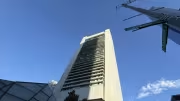
Perhaps my favorite discoveries involved the architecture of the city. I would learn that Buenos Aires has more dome-shaped roofs or cupolas than any other city in South America. The cupolas reflect the huge influx of European immigrants who began arriving in the late 1800s. As poor families became wealthy, they often acknowledged their ancestral cultures with nostalgic architecture. From the rooftop lighthouse of the Palacio Barolo, an office building erected by an Italian immigrant and designed by an Italian architect in homage to Dante’s Divine Comedy, visitors can enjoy a 360-degree view of the city. At night, the lighthouse’s beam flies over a variety of Spanish-, Italian-, and French-inspired domes before landing on the most famous one of all: the dome of the Palacio del Congreso, the Argentine Congress building.
During my visit to the lighthouse, I asked the tour guide why there were so few skyscrapers blocking the view. Although it is only 300 or so feet tall, the Palacio Barolo towered above the other buildings, and I was surprised to see so much beautiful architecture preserved from the late 1800s and early 1900s. The guide told me that Argentina’s economy had entered an economic crisis while the rest of the world was building skyscrapers, and by the time Argentines were wealthy enough to begin building again, they were too enamored of the old buildings to tear them down.
In some ways, travel writing during such a challenging time for Buenos Aires and Argentina was a similar blessing in disguise. Had I come during the high season or a time of economic and political prosperity, I likely would have had less incentive to learn about the local culture and think critically about Argentina’s cultural myths. Ultimately, despite the pessimistic diagnosis I read in the traditional media and heard repeated on the streets, I also saw many signs of transformation and growth. In my future travels and writing, I will remember to look out for these details to better understand the nuances of the cultures I explore.