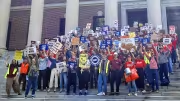
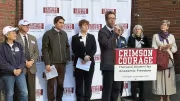
Despite pouring rain, a few hundred people, including Harvard students and Boston-area residents, gathered in front of Harvard Kennedy School (HKS) yesterday evening to protest the attendance of advisers to president-elect Donald Trump at the school’s post-election debriefing conference. The crowd condemned the appointment of Steve Bannon, M.B.A. ’85, the former head of far-right news website Breitbart who served as the CEO of Trump’s campaign, to White House chief strategist.
Bannon was originally scheduled to be at HKS yesterday for the post-election event at the Institute of Politics (IOP): “Campaign for President: The Managers Look at 2016,” along with other staff from the presidential campaign. He canceled that appearance on Tuesday due to a scheduling change, according to HKS spokesman Doug Gavel. More than 1,000 people had already indicated on Facebook that they would attend a protest of his appearance outside the school.
Despite the cancellation, students and others held the protest as a response to Bannon’s White House appointment, said Shanoor Seervai, an M.P.P. candidate. Several local groups, including the Boston NAACP, Jewish Voice for Peace, and refugee and immigrant advocacy groups also co-sponsored the protest.
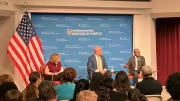
Harvard has hosted similar events after every national election for decades, with particular attention to presidential elections. Tonight, the IOP will host Trump campaign manager Kellyanne Conway and Hillary Clinton campaign manager Robby Mook for a post-election discussion: “War Stories: Inside Campaign 2016.” In a statement at yesterday’s event, HKS dean Douglas Elmendorf defended the decision to invite staff from both the Democratic and Republican presidential campaigns:
The campaign for president that has just ended has been especially divisive, and some guests who were invited to this event have already spurred strong reactions from members of our community. So, let me use this opportunity to explain the Kennedy School’s longstanding approach to visiting speakers and conference participants: We invite people who have significantly influenced events in the world even if their actions or words are abhorrent to some members of our community or are in conflict with the values of the Kennedy School itself…We invite speakers and conference participants who have significantly influenced events in the world even if their actions or words cause pain in our community or are at odds with our values because we think that a vigorous discussion of those guests’ actions and words can illuminate crucial issues in public policy and public leadership.
Protesters maintained this election year was unlike previous ones, and ought to be treated as such by Harvard. According to a statement released by student protesters, “Bannon’s established views run counter to American values of liberty and justice for all, which makes him unfit to advise on the governance of our nation. We are also calling on the media to reject normalization of his rhetoric, and demanding that our elected officials in Congress represent all of us, resisting dangerous policies that threaten to fight for only a small number of Americans at the expense of others.”
“Whatever the pretense or tradition, Bannon’s invitation to Harvard normalizes racist, sexist, and homophobic ideas that are being promoted from the highest office in the land,” said organizer Zachary Lown, a Boston-based attorney who is not affiliated with Harvard. “This was a campaign that was largely built on racism and fear, and we don’t view that as a legitimate part of our public discussion.”
Seervai was careful to distinguish the protesters’ repudiation of Bannon from the outcome of the election itself: “I accept the results of this election,” she said. “But what we can’t accept is a White House that is filled with leadership that stands for bigotry, hatred, racism, homophobia, xenophobia, sexism—these are all words that I would use to describe Steve Bannon.”
A letter circulated to the Harvard community calling on President Drew Faust to condemn Bannon’s appointment has received more than 3,000 signatures. Earlier this month, a group of 650 women graduates and students of Harvard Business School, from which Bannon also graduated, condemned him in a letter to The New York Times. Last week, Radcliffe Institute Dean Lizabeth Cohen, along with the presidents of six historically women’s colleges, signed a letter expressing deep concern about a comment attributed to Bannon that disparaged women who attended the “Seven Sisters.”
Protesters also suggested that Harvard must publicly commit to shielding undocumented students, whom Trump has vowed to deport during and after the campaign. “The first thing that Harvard could do would be to declare itself a sanctuary university,” Lown said. Faust went on record supporting such students earlier this week, in a message to the University community, writing that “the University does not and will not voluntarily share information on the immigration status of undocumented members of our community” and adding that Harvard would devote additional resources to advancing the interests of undocumented students. “We will also create a single, University-wide point of connection for students and administrators seeking information or guidance around undocumented students and other immigration concerns,” she continued. “[W]e recognize and share the deep anxiety that campaign rhetoric and proposals have created for many members of the Harvard community. Their cause—the opportunity they have earned through hard work to pursue their research, teaching, and education at Harvard—is our cause.”