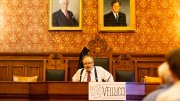
Eight years out of Yale—after stints as a U.S. Marine platoon leader and a teacher—Dwight D. Miller joined the Harvard College admissions office in July 1967. That was before the merger with Radcliffe; before the Supreme Court first ruled on affirmative action in admissions, in Regents of University of California v. Bakke (1978—and again in Grutter v. Bollinger, 2003; the multiple rounds of Fisher v. University of Texas at Austin, decided in 2016; and the current Students for Fair Admissions litigation against Harvard, possibly also headed to Washington on appeal); and before the global frenzy to gain a place at the nation’s selective colleges led to a tsunami of applications, plummeting admissions rates—and, in turn, a parental/high-schooler arms race to gain an edge through private counselors, test-prep courses, and ever-more applications filed by each anxious student.
At Harvard, where navigating thro’ this change and storm has meant attracting and reviewing an applicant pool that increased from fewer than 5,000 annually when Miller appeared on the scene to 43,330 hopefuls for the class of 2023, experience and perspective have been especially valuable. No one has personified that better than Miller, who served under admissions deans Chase N. Peterson, L. Fred Jewett, and William R. Fitzsimmons.
Now senior admissions officer, Miller, Ed.M. ’71, has covered most of New England; the Atlantic seaboard; a chunk of the Midwest; four southwestern states; for a quarter-century, Long Island; and Canada. Early on, he divided his time between admissions and service as senior advisor in the freshman dean’s office—and he was a proctor in the Yard from 1967 to 1990, the longest tenure known. Those engagements gave him deeper insight into the College experience and how applicants might get the most from, and contribute the most to, the place. Increasingly, those admitted have represented a far wider range of minority and ethnic backgrounds, and of socioeconomic circumstances.
On the downside, today’s applicants are “certainly much more uptight about the process,” Miller said, citing “the pressure on them to get into college A, B, or C—especially from the parents.” Withal, the experience accumulated within the admissions staff across the decades has enabled Harvard to winnow the applicants to find the “offbeat” ones who can thrive here, and contribute to the community in special ways. And he is grateful that “the sense of entitlement” that prevailed at mid century, when the applicants were so heavily weighted toward eastern prep schools, has dwindled away.
As he worked with alumni volunteers who interview applicants and support their education through philanthropy devoted to financial aid, Miller set out in the 1980s to gain formal recognition for their efforts. The resulting Hiram Hunn Award, created in 1986, honors the schools-and-scholarships foot soldiers; the eponymous Hunn, A.B. 1921, who did such work for 60 years in Iowa and Vermont (where he and Miller intersected for a decade and a half); and Miller himself, for his advocacy on their behalf. He was also recognized, directly, by the James ’72 and Rita Cain Scholarship fund, established by a former student in Grays Hall when he was proctor; it will be renamed upon Miller’s retirement.
That moment, amazingly, is now at hand, effective September 1. His Harvard admissions service extended nearly as long as Hunn’s, and accounts for more than a half-century of College classes, numbering thousands of undergraduates. No matter what changes in admissions unfold in the next five decades, no one in sight is likely to equal Miller’s record.