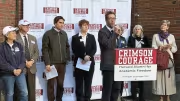
In the days leading up to Harvard’s Commencement, thousands of students found themselves in full regalia entering a common location steps away from campus: First Church Cambridge.
For the second year in a row, student groups from across the University organized affinity-based graduation celebrations without institutional support or access to Harvard-owned facilities. This year, six of the eight independently organized ceremonies were hosted by First Church.
“We are moving from a time that we have come to think of as normal—a time when institutions seem to embrace diversity, equity, and social justice—to the post-normal, when it appears as if we are picking our way through ideological quicksand,” Brown University professor of biology and gender studies Anne Fausto-Sterling said at Lavender Graduation, the celebration for LGBTQ+ graduates.
Ricardo Martinez, the executive director of GLAD Law, also spoke at the ceremony and acknowledged Harvard’s public resistance to federal pressure on higher education while criticizing the University’s move to collapse diversity offices last year.
“Pride and anger can coexist. Institutions are complicated, even the ones that are trying their hardest to live their values against a federal government that has targeted universities for what they teach, who they admit, and what they stand for,” Martinez said.
“Harvard has pushed back, and that matters, and I mean that sincerely. And even institutions fighting the right fights on one front can at the same time quietly retreat on another,” he added.
Amid those retreats, continuing the tradition of affinity celebrations felt “absolutely critical,” said Hannah Niederriter ’26, one of the ceremony’s student organizers.
“We wanted to make sure that students felt heard, they felt seen, that they could be in a space where their identity is celebrated, and regardless of how Harvard chooses to proceed in recognizing queer students in an institutional context, we wanted to make sure that they feel that they are our loved on Harvard’s campus,” Niederriter said.
The church became an ideal venue to many student groups because of its proximity to campus, though its capacity limited the size of some celebrations formerly hosted by the University, according to Asian American and Pacific Islander ceremony organizer Lillian Lining Zhang, A.L.M. ’24.
Zhang said the Harvard Asian American Alumni Alliance, which organized the celebration alongside student organizations, initially contacted the Harvard Graduate School of Education and Harvard Law School, seeking to host the event in a larger space.
“Unfortunately, they said that their hands are tied because they can’t host it officially,” she said. “We just waitlisted a lot of people, and basically turned down a lot of people, unfortunately.”
Two affinity celebrations were not hosted in First Church: Black Graduation, which was held in a hotel in Kendall Square, and the celebration for Jewish students, hosted at Harvard Chabad.
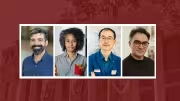
Several celebrations also included student awards recognizing leadership, scholarship, and contributions to campus communities. The Harvard Black Graduate Alliance gave the Titus Award in recognition of academic excellence and leadership to Kanto Raveloson, a master’s student at HGSE. The group awarded the Venus Award for creativity and cultural contribution to Candace Williams, a master’s student at Harvard Medical School.
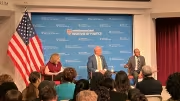
At the affinity celebration for graduating student veterans and their families, Tarr Family professor of bioengineering and applied physics Kit Parker, a colonel in the U.S. Army Reserve, described the University’s relationship with the military as cyclical, alternating between periods of close partnership and political conflict.
“Harvard was always there to ride with the American military,” Parker said, pointing to the University’s role in training officers during both World Wars and later to debates over ROTC’s presence on campus.
America is now in “this weird post-Covid, post-cultural convulsion moment,” Parker said, comparing universities to Renaissance-era trading hubs where technological and political change converged. He argued that veterans graduating from Harvard occupy an increasingly important role linking the military, higher education, and emerging industries shaped by artificial intelligence, biotechnology, and national security concerns.
“By virtue of having committed in the U.S. military and then transferred to Harvard, we hope you assume this mantle of responsibility,” Parker told graduates.
At Lavender Graduation, student speaker Annika Khandelwal ’26 described the ceremony as a reflection of the queer community she found at Harvard, rather than just a Commencement tradition.
“You gave me the strength to believe that people like me are worth studying for and fighting for,” Khandelwal told graduates and their families. “Ultimately, it has been my greatest honor to learn, think, dance, sing, cry, and just live alongside you all.”
“You taught me what real joy, queer joy feels like,” she added. “And I have one wish, as we all go into our post-grad lives, is that we never forget how community and celebration save lives.”
Fausto-Sterling, speaking later in the LGBTQ+ celebration, connected the present moment to an earlier era in higher education before universities formally supported programs centered on gender, sexuality, and race.
“I am old enough to have lived in the pre-normal,” she said, recalling a period “before there was any institutional support for studying gender, sex, and sexuality” and before Harvard appointed women or people of color to full professorships. “There were no institutional structures to promote or protect us, so we had to build our own.”
Still, she urged graduates to view Harvard’s current posture towards diversity efforts not as an endpoint but as a challenge to create more durable forms of community and institutional support.
“You can use your capacious imaginations and your fresh perspectives and abundant energy to imagine new ways of moving forward, maybe in ways that are a bit more armored against the kind of backlash that we are currently experiencing,” Fausto-Sterling said.