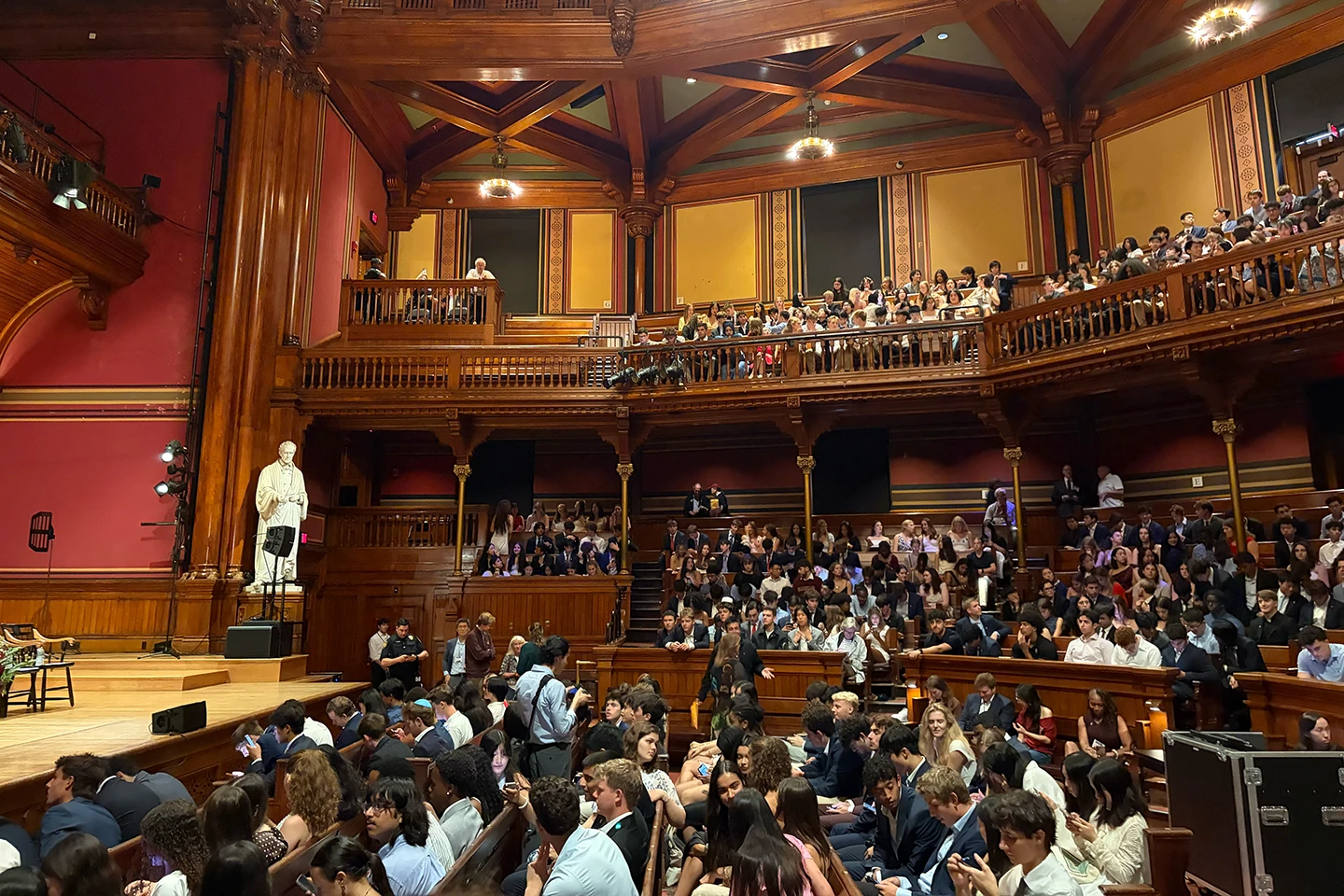
On Tuesday afternoon, President Alan M. Garber and University leaders gathered in Sanders Theatre to officially welcome a fresh batch of undergraduates to campus.
“Today we embrace you as members of the University community,” Garber told the Class of 2030 during the first of two divided-up Convocation ceremonies, which were moved indoors from Tercentenary Theatre due to wet weather. The program included remarks from administrators, as well welcomes from Harvard Undergraduate Association co-presidents Zach Berg ’28 and Daniel Zhao ’28 and Harvard Alumni Association president David Battat ’91.
In his remarks, Garber called the work being done at Harvard every day “astonishing,” and asked the assembled students how “you, the newest members of our community, determine where you might fit into this vast constellation of excellence and ambitions?”
Garber recounted his own Harvard journey, drawing parallels between 2026 and 1973, when he first arrived on campus as a first-year student from Rock Island, Illinois.
“Every student had a typewriter. Every typewriter had an ink-saturated ribbon, and every ribbon ran out of ink just before a big paper was due,” he said. But “the experience of adjusting to college life has changed little over time. Each of us leaves the comfortable and the familiar, both eager and uneasy. Each of us looks for ways to orient ourselves and connect with others. Each of us worries, maybe a little, maybe a lot, about whether we made the right decision.”
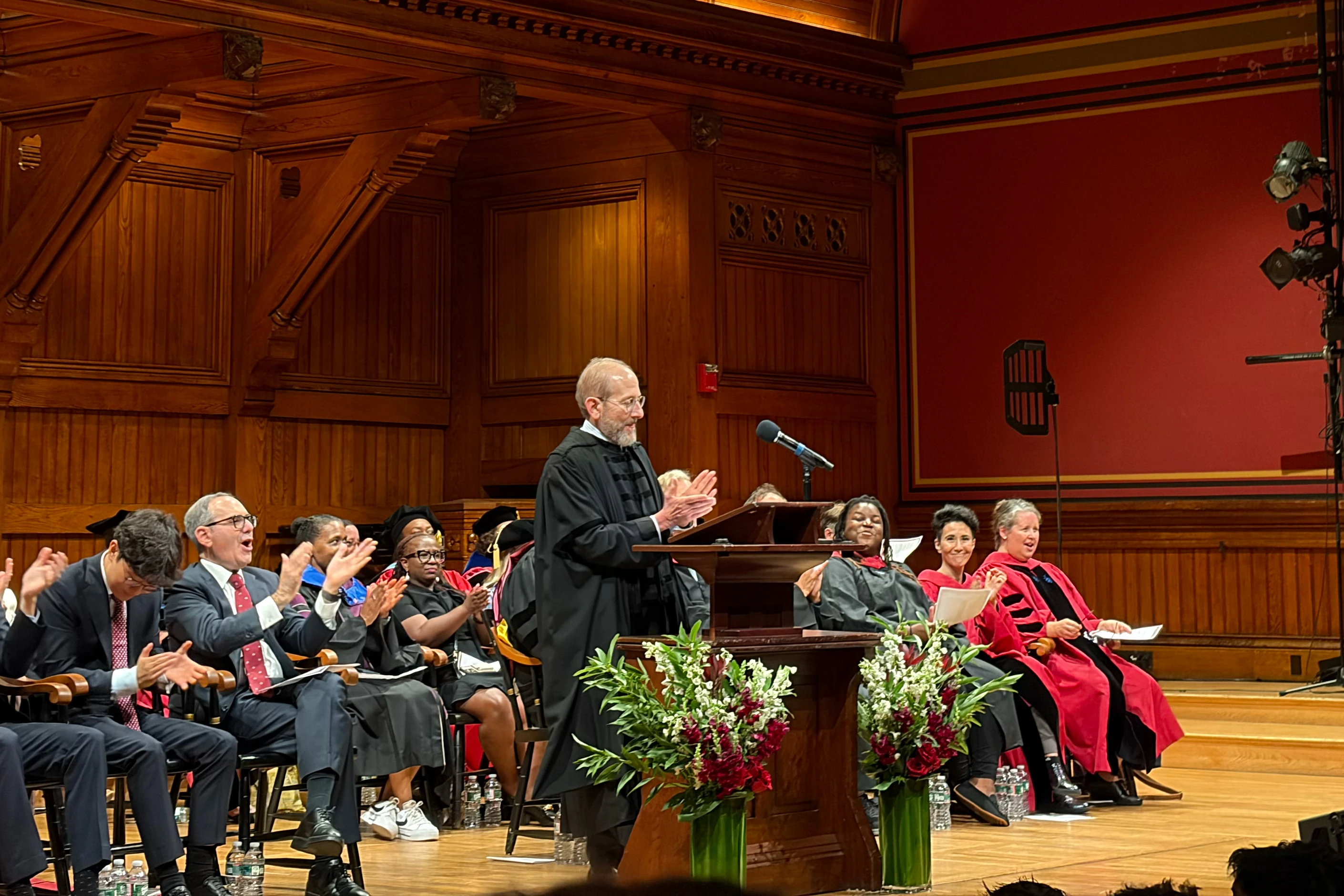
He encouraged the students to embrace the surprises their undergraduate journeys would bring, and to be open to the good advice all around them.
“If you get a sense that someone sees something in you—a talent, capacity, or passion that you haven’t recognized—listen carefully and take their suggestions seriously,” he advised. “They may identify an unexpected spot for you in constellation Harvard, and you may find yourself shining more brightly than you ever imagined.”
In their remarks, Danoff dean of the College David Deming and Amanda Claybaugh, the dean of undergraduate students, both recounted key moments in Harvard’s history and offered up overviews of how the aims and priorities of an undergraduate education have evolved since the University’s founding.
“Why are you here?” Deming asked the crowd. “For most of the life of this great university, the answer has been blindingly obvious, but it hasn’t always been the same.”
Knowledge, he said, has grown increasingly accessible over time. Harvard was founded in 1636 with a small, hard-to-access library; today, the internet and AI have made acquiring knowledge both widely available and customizable, culminating with AI-assisted tutoring.
“AI is curating expertise on students’ behalf,” he said. “But expertise alone doesn’t make for a great education, or even a good one. This misunderstands what a university is for.”
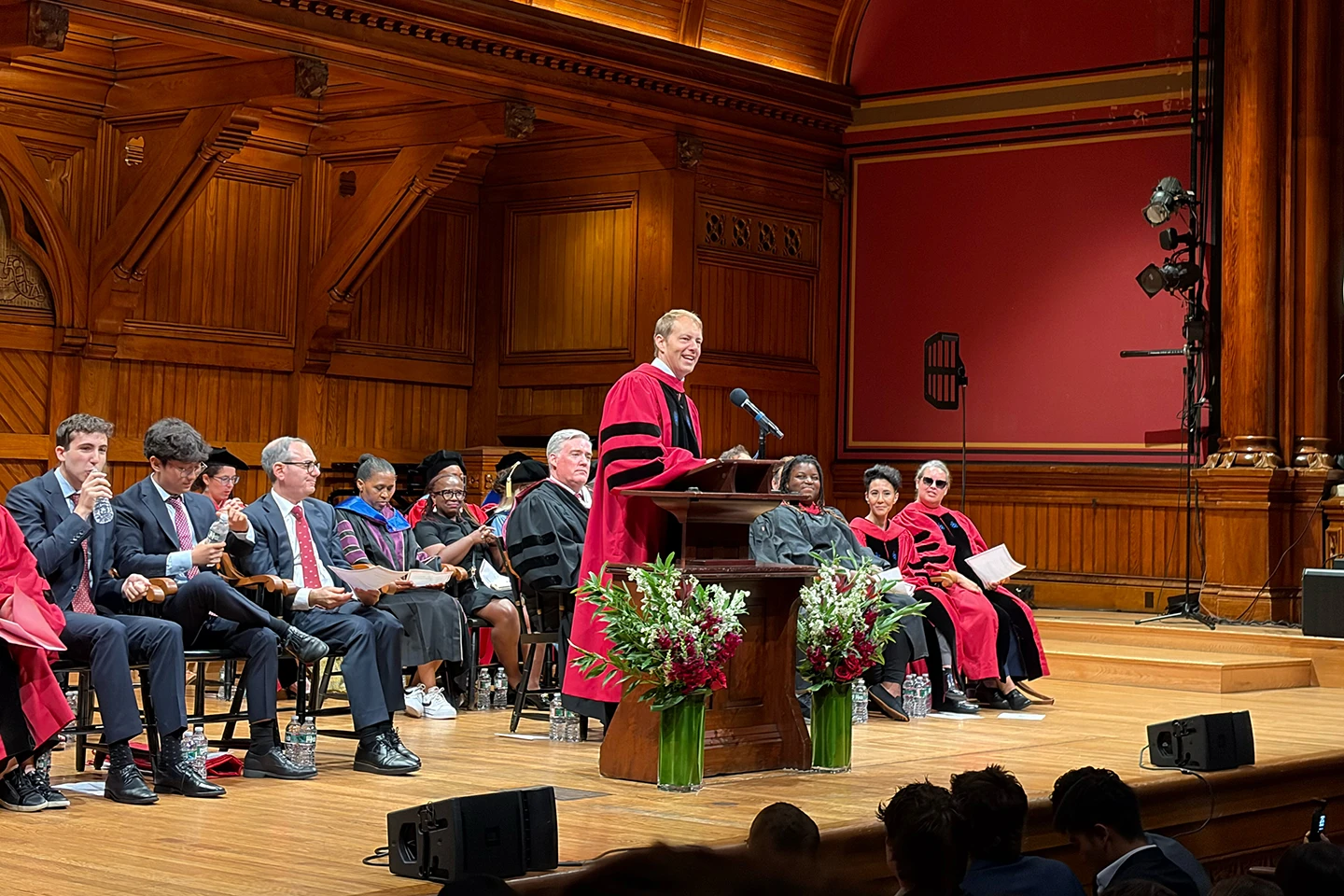
Community, he stressed, is the differentiator, and he encouraged students to make the most of Harvard’s. “The next time you are tempted to stay in your room and stream video because your social battery is drained, go to that event anyway,” he advised. “Almost always, you will come back feeling energized and happy again.”
In her remarks, Claybaugh traced the evolution of the liberal arts education from the fourth and fifth centuries to Harvard’s present-day general education requirements. No matter the era, she stressed, the goal was to create good, fully-rounded citizens of the world—and for students to come to better know themselves.
“I encourage you…to use your liberal arts education to consciously cultivate the self, whatever that means for you,” she said. “All of you will work, and it makes sense that your future careers are on your minds. But you have been given a very rare gift: four years of leisure to learn about yourselves and your places in society and the cosmos, and I hope that you will make good use of it.”