Behind the Scenes: The Making of a Revolutionary Issue
Editor Joanna Weiss and creative director Jennifer Carling on the May-June 2026 special coverage of Harvard’s role in the American Revolution
Harvard Magazine editor Joanna Weiss and creative director Jennifer Carling discuss how the May-June 2026 issue came together—from early ideas and reporting to illustration and design.
From editor Joanna Weiss:
What inspired you to pursue this “Harvard Celebrates the 250th”-themed issue?
As we approached the nation’s semiquincentennial—a new word I learned this year!—we started to hear ideas, from all around the University community, about Harvard’s role in the Revolution. Sometimes, that role was physical: the doorknobs of Harvard Hall melted down to make musket balls. Often, it was intellectual: the Enlightenment values that marked a Harvard education in the eighteenth century were a giant inspiration to the Patriots. We loved the idea of highlighting the ways Harvard’s history is intertwined with America’s.
Can you walk us through the planning and reporting process—from the initial concept to the final publication?
The reporting and suggestions came from all over. Marc Goodheart, a longtime University leader who is currently a senior advisor to Harvard’s president, helped us identify Revolutionary sites around campus, along with many Patriots who had Harvard ties. A history writer dug into the archives of Concord, Massachusetts, to learn about the year troops were quartered in the Yard and Harvard students were exiled to Concord; a Harvard M.P.A. graduate who lives in Warren County, Ohio, wrote about the county’s namesake, Harvard-educated general Joseph Warren. Members of our staff researched poets, politicians, abolitionists, and the Native Americans who fought in the war. We wanted to cover the breadth of Revolutionary-era experiences and highlight some fascinating eighteenth-century characters who are no longer household names.
What kind of research went into shaping this issue, and how did you decide who or what to focus on?
The hardest thing was deciding what to leave out in our limited print space! We have more stories online that cover some quirky aspects of 1770s history, such as the bright blue sash George Washington wore to distinguish himself from the troops (now on display at the Peabody Museum of Archaeology and Ethnology). We’ve also published a list of 250th-themed events and exhibits hosted around Harvard this spring and summer. And look out for some fun videos on social media later this spring that will highlight Revolutionary sites around Cambridge.
Were there any stories that surprised you, or ones you found especially meaningful or enjoyable to work on?
I was inspired by Lydialyle Gibson’s story of Darby Vassall, the Black abolitionist who had a memorable (if apocryphal) boyhood conversation with George Washington in what would later become Longfellow House. And I loved reading the poetry and letters of Mercy Otis Warren, the wife and sister of Harvard graduates, who wrote the sauciest, most caustic missives to her friend John Adams, urging him to get on with it and start a revolution already.
From creative director Jennifer Carling:
This issue is incredibly rich visually—what was your overall creative vision?
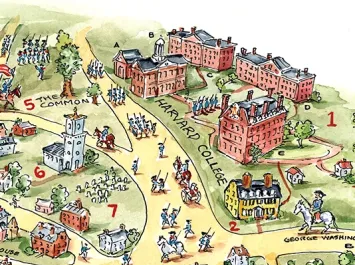
When thinking about the articles and the cover, we didn’t want to rely too heavily on historical images. Mark Steele’s amazing artwork instantly came to mind. Mark has been creating illustrations for Harvard Magazine since the 1990s and has a wonderful talent for capturing the look and feel of the campus while also injecting a strong sense of the people who inhabit it. While maintaining historical accuracy with the buildings (with a touch of artistic license), he was also able to weave in the richness of life at that period, with a flair for humor and playfulness.
How did you approach translating the themes of the stories into the cover and other visual elements?
As a child, I was introduced to the book Busy Busy Town by Richard Scarry, and I found myself mesmerized by the detailed illustrations and the thrill of finding new tiny gems that transported me to Scarry’s world. We wanted the cover to have this feel. The idea was to illustrate a “bird’s eye view” of the campus in 1776: not just the buildings, but the hustle and bustle of an active community, the soldiers living on campus, the townsfolk going about their daily business, and some hidden gems like George Washington on his horse, Mercy Otis Warren reading her poetry, and soldiers removing lead off the roof of Harvard Hall to use for musket balls.
Weaving Mark’s amazing illustrations into the rest of what we called the “Revolution package” helped bring the stories to life. He illustrated a small male figure (who I referred to as our “little colonial guy”) engaged in different activities: being a soldier, a town crier, and a student, and even enjoying a tankard of beer at a pub. He also appears in other magazine features: Treasure, Introductions, and the letter from the editor, which all have “Harvard and the Revolution” themes.
We knew a map of Cambridge during that period would be the obvious opener for the package. While not created to scale—and taking some artistic license, in terms of relative locations—it is loosely based on a map of that time period that is housed in the Harvard University Archives. Mark also illustrated the Harvard exodus to Concord, Joseph Warren’s life as a Harvard student, and Mercy Otis Warren working into the night, feverishly writing her poetry and prose.
How long did the design process take, from early concept through final production?
We typically have two months to pull an issue together—and it takes the full two months to do it. I spent hours researching historical images to provide Mark with reference materials and guide him through versions of sketches to get it just right. At the same time, I researched historical portraits and art for some of our other subjects. Our sketches evolved as we finalized the illustrations and the content came into better focus, but my initial plan remained intact.
What do you hope readers take away from this issue?
Jennifer:
I hope readers learn something that they did not know about Harvard and its involvement in the Revolution—and that they have fun learning it. And I hope they take the time to look at the illustrations and find all the fun elements tucked in. Whether you enjoyed Richard Scarry’s books, Where’s Waldo?, or both, I think most can relate to the joy of discovering the details.
Joanna:
I hope readers feel, as I do, that they’ve learned something surprising about the people who created a nation. And I hope the next time they come to Harvard Square, they see these familiar buildings and streets in a new way. We all share a connection to Harvard’s rich past, and I’m grateful to our donors, who enable us to bring that history into the present.
Explore “250 Years Ago, Harvard Was Home to a Revolution”