George Washington was a smart dresser. High-quality fabrics. Fitted suits. He was aware of how clothing made a statement. So, it’s not surprising that after arriving in Cambridge in 1775 to take charge of the Continental Army—an unkempt crowd of “provincials under very little command, discipline, or order,” as he wrote to his brother—he sought to differentiate himself.
His individual style came in the form of an elegant, bright blue, taffeta silk sash worn boldly across his chest. “When he first wore it is unknown,” says Horace D. Ballard, the Stebbins Jr. curator of American art at the Harvard Art Museums, who authored the forthcoming book George Washington, Slavery, and the New Politics of Style, 1743-1789. But documents show, Ballard says, that on July 10, 1775, eight days after his arrival, Washington bought a ribbon for three-quarters of a pound sterling, noting that it would “distinguish myself.”
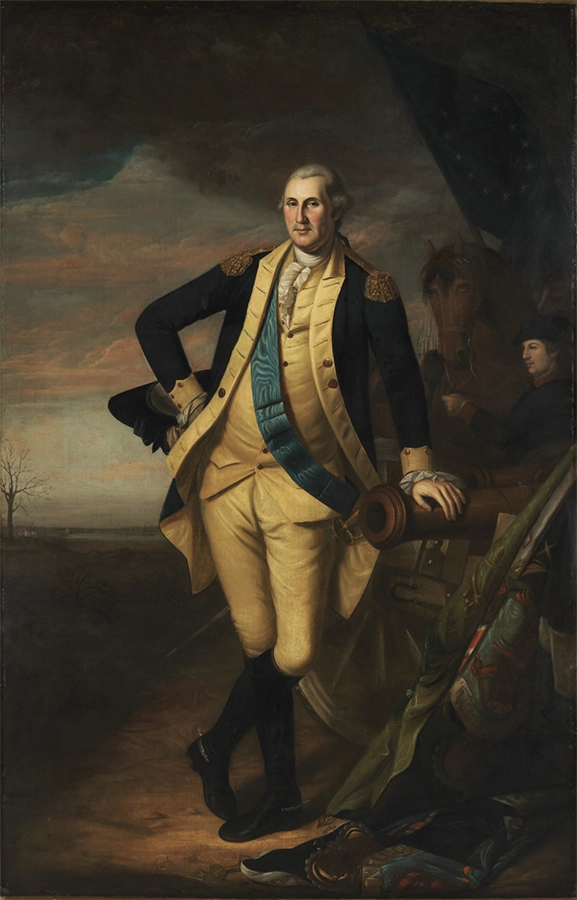
The sash appears in the 1779 commemorative battle portrait Washington at Princeton, among Charles Willson Peale’s famous paintings of the leader, but it is absent in paintings created after that year. Ballard suggests that Washington had stopped wearing the sash by 1779-1780, based on a letter from a French soldier that says the general had worn it on formal, solemn occasions, but “has given up that unrepublican distinction.”
Perhaps the leader of the burgeoning nation was recognizable enough by then? Perhaps the sash was too close to the blue color associated with chivalric British orders and emblems of the peerage or the British crown? Whatever the case, Peale, who later opened a Philadelphia museum of natural artifacts and other objects, ended up with the garment. It passed from his collection to the Boston Museum and, when that closed in 1899, to Harvard’s Peabody Museum of Archaeology and Ethnology.
There, the sash will be on display at the Peabody museum from May 25 through October 18, as part of the University’s celebration of the American Revolution’s 250th anniversary. (Also on display at the Harvard Museum of Natural History are two pheasants once owned by Washington at Mount Vernon.) “When we see something associated with such a notable character from the past,” says Diana Loren, the Peabody deputy director for curatorial affairs and senior curator, “it brings that history to life in a different way. History becomes more personal to us.”