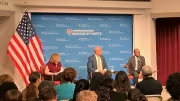
Jason Furman ’92 and Nick Hanauer both believe in the transformative power of capitalism. On its surface, that might seem like a sleepy premise for an economic debate. But on a Thursday livestream for the program Open to Debate, the Harvard Aetna professor of the practice of economic policy and the billionaire investor sparred energetically over whether that power is being wielded properly in the United States.
Furman, for the most part, thinks it is.
In terms of the economy, “today is the best time ever to live,” Furman argued, citing statistics showing higher wages, better standards of living, and stagnant levels of inequality over the past 25 years. “That’s true not just for the wealthiest Americans, but for people in the middle class. It’s also true for the poor.”
Hanauer, one of Amazon’s earliest investors, agreed that free markets are “the greatest social technology ever created for creating prosperity.” But he took a counterintuitive position for a wildly successful venture capitalist, arguing that in practice, free market capitalism in the United States has outlived its usefulness for most of society.
“Americans are now 79 trillion dollars poorer, less secure, and less resilient than they would have been, had capitalism not concentrated wealth at the very top,” he said. “This is a failed ideology that is taking our republic down with it.”
Moderated by Open to Debate host John Donvan, Furman and Hanauer brought to the table starkly different visions of what a well-functioning capitalist free market ought to look like. Furman, who chaired the Council of Economic Advisers during the Obama administration, argued that allowing competition to flourish should remain the fundamental core of an effective capitalist system—the driving factor behind every improvement from product innovation to increased wages.
“Markets are about a voluntary transaction,” he said. “One person has something, the other person has something else, and they trade. Maybe it’s time. Maybe it’s money. Maybe it’s products. Letting people make those choices is a wonderful thing.”
As an example, he cited housing, which, despite serious affordability issues, has broadly improved.
“Over the last 50 years, we’ve gone from a situation in which the typical family had fewer rooms than people to one in which it has more rooms than people,” he said. “Indoor plumbing has become universal. Extreme overcrowding is a thing of the past. More children have their own bedroom today than was the case even 10 or 20 years ago.” Furman argued, too, that tight regulations on developers and rent control laws have only hampered continued improvement.
Hanauer, however, countered that in practice, free market capitalism has mutated into a system prioritizing returns for shareholders, rather than societal prosperity.
“In the 1970s wages were about 51 percent of this economy,” he said. Today they’re about 41 percent, the lowest share ever recorded. Corporate profits went the other direction, rising from 6 percent to 12.4 percent. In 1985, it took a typical American 40 weeks of work a year to afford housing, healthcare, transportation, food, education, and the other essentials of the middle-class life. By 2022, it took 62 weeks.”
Likewise, the two men had vastly different ideas about how to improve the current system. Hanauer argued for a drastic paradigm shift, into “free market humanism,” an economic structure devoted to “human flourishing.”
“The more people we fully include in the economy, the faster and more prosperous and more innovative it grows,” he said, though he did not offer specifics about how companies might change to fit that ideal.
Furman called it a pipe dream. “You’re just going to pass a law and say every American company now needs to be nice?” he said. “We’d like corporations to do the right thing. I confess I’m extremely cynical about it. No amount of cajoling is going to change them very much. What will change corporations is competition.”
He argued, too, that some of the accountability Hanauer called for is a natural consequence of a functional free market—and that it could be strengthened by government regulations, a progressive tax system, and a strong social safety net.
“Companies that develop a reputation for treating their customers badly, for treating their workers badly, can end up being punished in the marketplace,” Furman said. “Some of our biggest and most successful companies have reliably delivered lower prices, greater variety, and better products. That’s why Amazon is the way it is, not because it’s cut every single corner.”
The two men went on to debate certain particulars of the economic system, including CEO pay (which Furman called a “distraction”) and the role of public assistance such as food stamps, before delivering closing arguments.
“I love markets, and they are indispensable foundations of prosperity and free societies,” Hanauer said. “But understanding that markets work is not the same as understanding how and why markets work or how to make them work better. Capitalism, as it is practiced today, isn’t just broken; it’s wrong.”
Furman countered: “If you look at countries that are richer, countries that are growing faster, countries that are more innovative, you tend to have people that are happier, more tolerant of each other, more willing to share, have lower maternal mortality, lower child mortality, higher degrees of well-being in a whole variety of even more fundamental dimensions. The United States right now, compared to almost any rich country on the planet Earth, is doing a better job of generating economic growth.”
Watch Furman and Hanauer’s debate below, released as a podcast and aired on NPR stations on August 28. Listeners across platforms can vote for a winner from 8/28-9/4.