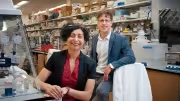
Martin Chalfie ’69, Ph.D. ’77, now Kenan professor of biological sciences at Columbia University, and Roger Y. Tsien ’72, now professor of pharmacology at the University of California, San Diego, School of Medicine, and professor of chemistry and biochemistry at UCSD, are two of the three scientists awarded the Nobel Prize in Chemistry, for fundamental work on the green fluorescent protein, isolated from jellyfish, now a basic tool used to study biological processes within cells. The prize announcement and accompanying explanatory information for the public are available at the Nobel website.
Chalfie's home page and Tsien's laboratory website provide further information on their current work.
Writing in his twenty-fifth anniversary report, Chalfie noted that after three years of "odd" jobs following his graduation, "I started what has turned into a real job: biological research." He saluted his doctoral adviser, Bob Perlman, and especially his postdoctoral colleagues in Cambridge, England, "who by their example and enthusiasm made me strive to do significant research and to try to avoid any self-imposed barriers. They also taught me that sharing, not hoarding, information was the most satisfying way of operating in this business." Speaking of his love for genetics and his work with the roundworm, C. elegans, Chalfie said he was trying to understand "the molecular mechanisms underlying cell differentiation (how different types of cells, in my case a specific set of nerve cells that act as touch receptors, arise), inherited nerve-cell degeneration…and early events in the sensing of mechanical stimuli (which are the bases of our senses of touch, position, and hearing)." Ten years later, he wrote, "Life and lab continue to be pretty enjoyable (especially this year, since I am on sabbatical).…"
Tsien, who is a Howard Hughes Medical Institute investigator, wrote in his twentieth class report of his 1989 move from the Bay Area to San Diego, and of working with colleagues "to design and use new molecules to probe intracellular signal transduction. The move brought major improvements in research environment at the price of some sacrifices in local climate and scenery. Still, we can't complain."