A chartreuse jumpsuit featuring irises, butterflies, and an embroidered bustier. A slinky emerald-green sequined gown with crystal trim and a rhinestone belt. A fitted cobalt blue coat with a black fur collar and decorative closures known as “froggings.” See these glamorous ensembles, and many more, on display in Andrew Gn: Fashioning the World, at the Peabody Essex Museum in Salem, Massachusetts. Nearly a hundred items—the outfits, along with accessories, illustrations, and biographical notes—shed light on the creative process and careful craftsmanship of this renowned artist. “He drew from art, history, pop culture, and cross-cultural influences,” building an eclectic line of clothing, says chief curator Petra Slinkard. Although worn by royalty and celebrities around the world, his outfits offer an ease unusual in haute couture, she adds, “so women can step in, zip up, and go.”
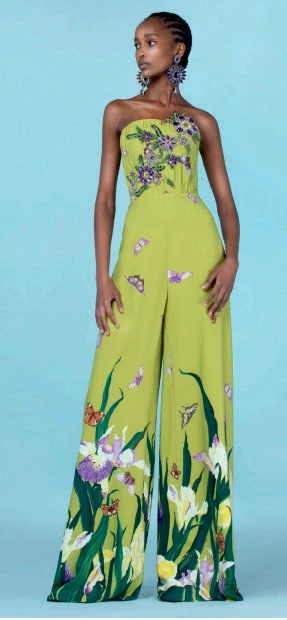
Born to immigrant parents in Singapore in 1966, Gn (pronounced “gin” with a hard “g”) was encouraged to travel and ultimately studied in Paris, New York City, and Milan before founding his Paris atelier, The House of Andrew Gn, in 1995. What “began simply in his apartment with an assistant and a sewing machine,” Slinkard says, grew into a 28-year business that produced 80 collections and some 10,000 ensembles. One of the few independent fashion houses to succeed financially, the atelier (which closed in 2023) is known for rich ornamentation, impeccable materials, and the artist’s disparate global aesthetic. Gn integrates aspects of his own “Singaporean lived experience,” says Slinkard, along with “the colors, textures, and patterns from Southeast Asia.” Thus, a chinoiserie silk caftan with ostrich feathers was inspired by motifs in traditional Chinese lacquered screens and the chartreuse jumpsuit echoes a nineteenth-century kimono owned by his mother. Slinkard hopes visitors to the show “experience something they were not expecting,” she says, “and walk away having learned something about another culture, time period, and form of creation.”