“Radio Contact” at Harvard’s Collection of Historic Scientific Instruments

Radio was the medium that broke the silence.

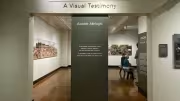
First of four photographs showing the “Radio Contact” exhibit at Harvard’s Collection of Historical Scientific Instruments

Scenes from an exhibition: “Radio Contact” at Harvard’s Collection of Historical Scientific Instruments

Photograph by Samantha van Gerbig/Courtesy of the Collection of Historical Scientific Instruments

Photograph by Samantha van Gerbig/Courtesy of the Collection of Historical Scientific Instruments

Photograph by Samantha van Gerbig/Courtesy of the Collection of Historical Scientific Instruments

Photograph by Samantha van Gerbig/Courtesy of the Collection of Historical Scientific Instruments

How many people in the room remember what they were listening to on their bedroom radios in 1945 when the broadcast was interrupted with the news that President Franklin D. Roosevelt had died? This correspondent remembers. He was listening to The Lone Ranger: “Return with us now to those thrilling days of yesteryear! From out of the past come the thundering hoofbeats of the great horse Silver! The Lone Ranger rides again!”

The Collection of Historical Scientific Instruments, in the Science Center, has opened a new exhibition in the second-floor Special Exhibition Gallery called “Radio Contact: Tuning In to Politics, Technology & Culture.” It runs through December 9 and is open to the public free of charge.

Radio broadcasting roared onto the scene in the 1920s, when the first commercial broadcasting stations hit the air with a variety of programs. An introductory text panel for the exhibition sets the scene: families gathered around their sets to hear news on the day it happened. An opera performed in the city could be enjoyed upstate; a Chicago baseball game on the farm. The next 30 years were a Golden Age. Radio delivered dramas such as The Shadow and Mary Noble, Backstage Wife. It introduced millions to jazz, the comedic duo of Abbott and Costello, the iconic voice of newsman Edward R. Murrow.

The exhibition examines the changing technology and culture of listening, tinkering, and broadcasting. The listening section includes a six-speaker sound installation and interactive radio. Museumgoers can listen to once-live news broadcasts of historic events, play-by-play of sporting events, oldie-but-goodie songs, and past political harangues.

“Radio Contact” offers temptations to explore to visitors of most ages, from the old boy wanting to revisit the thrilling days of yesteryear, to today’s well-wired child. Several curatorial students helped assemble the exhibition, and some of them may have learned to their surprise that tuning a radio might require more than pushing a button. They may have learned that grandparents or parents, as teenagers, were out in the garage messing around with crystal sets they had built themselves, fiddling with the so-called controls to hear the faint, unamplified voice of another human being out there on the airwaves trying to communicate.
Read more articles by Christopher Reed
Related topics

You might also like

There’s a New Sargent Painting in Town

Harvard Art Museums restores a rare glimpse of an American master.

Don’t Call Stephanie Pierce A Paleontologist

From competing in youth gymnastics to studying tetrapods, the Harvard curator has always chased her curiosity.

At Harvard’s Peabody Museum, Photos Reimagine Iranian History

Artist Azadeh Akhlaghi reconstructs moments of Iranian political upheaval in a series of meticulously staged images.

Most popular

Harvard Weathers a Year of Turmoil

The federal government has launched unprecedented actions against the University. Here’s a guide.

Lafayette’s Unexpected Gift to George Washington: Pheasants

The two birds will be on display at Harvard this summer.

Harvard Alumni Win Two 2026 Nobel Prizes

Karl Deisseroth revolutionized neuroscience. Navanethem “Navi” Pillay has adjudicated cases in international courts concerning genocide.

Explore More From Current Issue

A smiling elderly man in glasses sits comfortably in a striped armchair.

Plus, veteran higher education leader Thomas Ehrlich reflects on university curricula for his 70th reunion

A vase of yellow flowers on a table next to an orange and a glass.

Harvard Art Museums restores a rare glimpse of an American master.

Portrait of a man in a denim shirt beside a blue book cover for "Gretal and the Great War" featuring an illustration of a leg holding an army helmet..

The Gretel and the Great War author on how the Lampoon derailed his science career—and set him on a literary path.