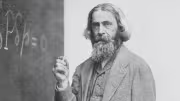
Even by the relaxed standards of the Faculty of Arts and Sciences (FAS), the interval between the death of Weatherhead University Professor Samuel Huntington (in late 2008) and the presentation of the memorial minute on his life and services (at the November 7 faculty meeting) was extraordinarily long. But it proved fruitful for the content of the memorial, prepared by Malkin research professor of public policy Robert Putnam, Geyser University Professor emeritus Henry Rosovsky, and Kaneb professor of national security and military affairs Stephen Rosen, who presented it.
“American Politics: The Promise of Disharmony was perhaps his most original work,” the trio noted. “The observation that the United States was defined not by blood but by a set of political principles is commonplace. Huntington pointed out that every 50 years or so, American society was aroused by a renewed commitment to the principles of liberty and equality and, in the grip of what he called ‘creedal passion,’ Americans would attack the government by demanding that it actually live up to those principles. Huntington noted these periods of passion: the Revolution, the Jacksonian era, the anti-slavery movement of the 1850s, and the first wave of feminism and the call for direct democracy…at the turn of the twentieth century. Starting in the 1950s and contining into the 1960s, there were the civil rights movement and the second wave of women’s liberation. On the basis of this cyclical understanding of American politics, in 1991 Huntington presciently predicted another wave of creedal passion in the second and third decades of the twenty-first century, when the invevitable frustrations with reforms would lead to calls for authoritarian efficiency.”
Turning to the book for which Huntington is perhaps most widely known, the memorialists put The Clash of Civilizations and the Remaking of World Order into what they regard as its proper context. The title, they noted, was “chosen by the publisher of the article that gave rise to the book and [was] not one that he particularly liked.” Though today the work is often put to partisan purposes—viewed as a call for, or prediction of, tribal strife—the writers maintained that “The core of the argument is that you cannot understand what people want until you understand who they think they are. Religious beliefs shape identity but do not determine interests, much less behavior. Civilizations do not inevitably clash.…If the events of 9/11 and after led others to see a world locked in wars among civilizations, this was not Huntington’s conclusion. In that book and in his final years he was a strong advocate of international multiculturalism, a policy of live and let live and non-intervention in the ways of life of other cultures.”